
THE GREEN GOLD RUSH: JHARKHAND SET TO LEAD INDIA’S TECH BOOM
Strategic Report Outlines 5,500-Ton Annual Graphene Production Powerhouse
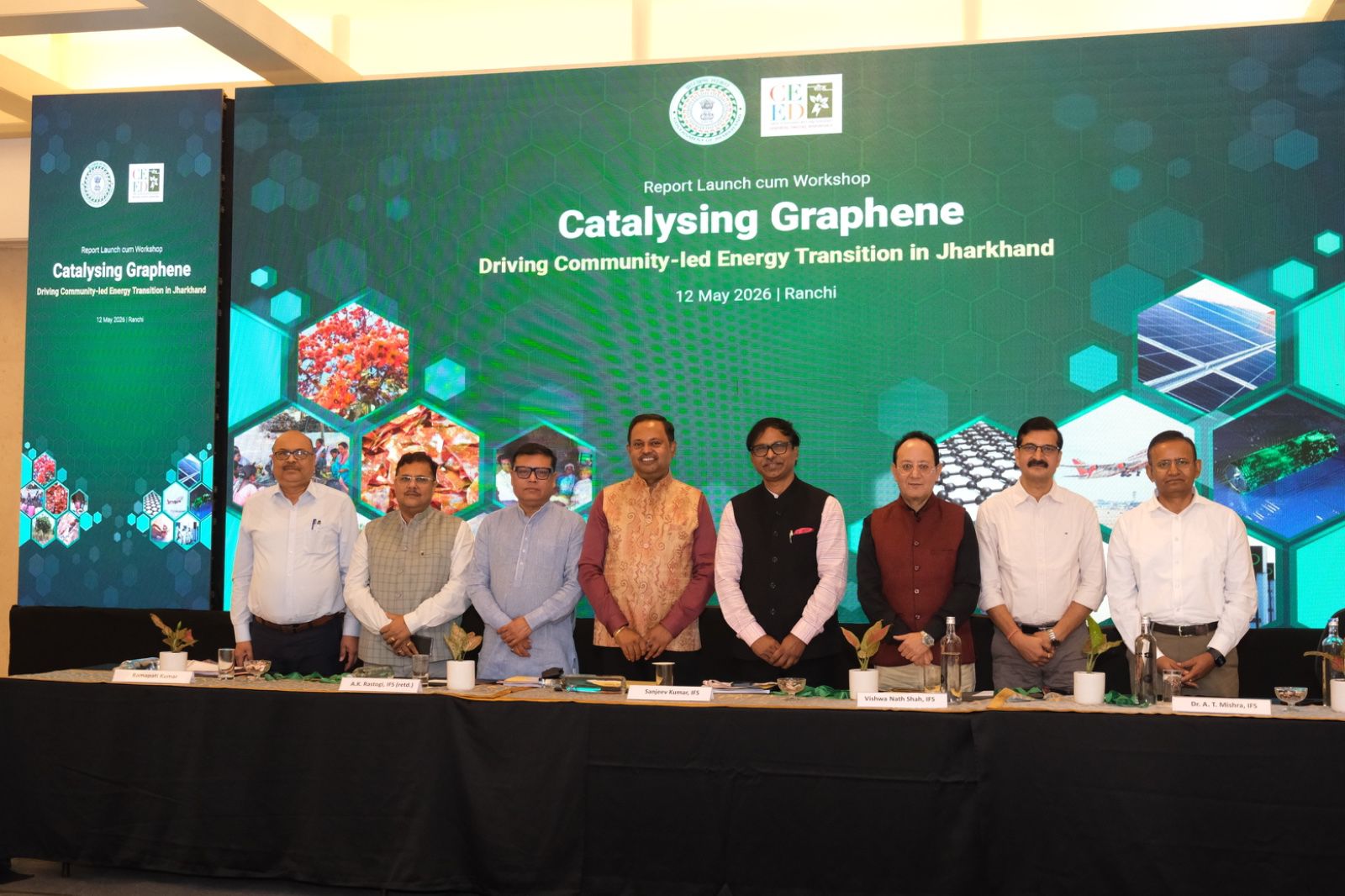
RANCHI: In a major move toward sustainable industrial growth, the Task Force-Sustainable Just Transition and the Center for Environment and Energy Development (CEED) have launched a landmark report titled ‘Green Gold: Unlocking Graphene for Community-led Energy Transition in Jharkhand’.
The study reveals that Jharkhand is uniquely positioned to become a global hub for manufacturing graphene—a high-impact ‘wonder material’ driving innovations in clean energy, electronics, battery storage, healthcare, and advanced manufacturing.
The Ultimate Material Trifecta
Jharkhand holds an unmatched competitive edge as the only state in India boasting all three natural precursors required to manufacture graphene: shellac (lac), graphite, and coalbed methane. Most notably, the state accounts for 55 percent of India’s and 24 percent of the world’s total lac production. This renewable bio-resource serves as the foundation for producing eco-friendly “green graphene,” directly aligning the state with India’s net-zero carbon commitments and circular economy goals.
Massive Production Scale
With strategic investments and innovation-led partnerships, Jharkhand has the capacity to produce nearly 5,500 tonnes of green graphene annually. Government leaders, including Forest Secretary Shri Aboobacker Siddquie P. and Task Force Chairperson Shri A.K. Rastogi, emphasized that building a comprehensive public-private manufacturing ecosystem will successfully transition the state toward a high-value, regenerative economy.
Uplifting Rural and Tribal Economies
Unlike traditional heavy industries, Jharkhand’s green graphene blueprint links high-tech industrial transformation directly with rural livelihoods. By utilizing lac-kusum cultivation, the ecosystem will generate widespread economic opportunities for tribal populations, women-led enterprises, and forest-dependent communities.
A technical panel featuring experts from Tata Steel, ICAR-NISA, and green-tech startups concluded that moving toward economic diversification, fostering technology incubation, and strengthening rural cooperatives will pave the way for long-term climate resilience and localized employment across the state.
