
Beyond the Proxy: Houthi Agency, Maritime Security and the Political Economy of the Saudi–Yemen Conflict
By Yumna Samim and Habiba Fatima
The Saudi-Houthi conflict was not merely the result of geopolitical rivalry between Riyadh and Tehran, but rather Yemen’s domestic political shift. Indeed, the Houthi group, whose official name is Ansar Allah, is an offshoot of the Zaydi Shia minority living in northern Yemen, which became an armed political group due to grievances regarding political marginalization, state power, and power distribution. The Houthi movement should be considered in the context of Yemen’s political instability caused by the reign of President Ali Abdullah Saleh and the partial political transition after the 2011 uprisings.
One attempt to create a framework for political transition was the UN-sponsored National Dialogue Conference held in January 2014, where 565 delegates were present. However, disagreements over federalism, political representation, and the distribution of power during the transition fueled tensions. On September 21, 2014, Houthis and allied military forces took over Sanaa, the capital city of Yemen, severely destabilizing the internationally recognized political transition process. This takeover turned the Houthi insurgents into a central political actor in the fight for power in Yemen.
The Saudi military’s involvement on March 26, 2015, represented a crucial turning point in the conflict following the breakdown of the previous political arrangement. After Yemen’s President Abdrabbuh Mansur Hadi asked regional partners for military help, a coalition led by Saudi Arabia entered the country to support the Yemeni government, beginning with Operation Decisive Storm directed at Houthi forces. Riyadh’s actions aimed to re-establish the government’s authority, prevent a hostile armed group from consolidating along its southern border, and curb the spread of Iranian influence in the Arabian Peninsula.
Nevertheless, the intervention turned what was already a fragmented civil conflict into a long-lasting regional security crisis. The military operation failed to achieve a clear political resolution, and years of fighting have led to high civilian casualties, widespread destruction of infrastructure, and a severe humanitarian crisis. The conflict also exposed the limits of conventional military superiority when facing an opponent capable of using asymmetric methods such as drones, missiles, and cross-border attacks.
The Iran Factor: Is Yemen Really a Saudi–Iranian Proxy War?
Iran and the Houthis have become intertwined in the Yemen conflict because their relationship connects to the larger rivalry between Tehran and Riyadh. From a security standpoint, Saudi Arabia is acutely aware of the threats on its southern border, particularly the proximity of armed groups to Saudi territory. Iran’s support for the Houthis—such as supplying missiles and drones—has made Riyadh realize that the conflict is not solely about internal Yemeni power, but external dynamics as well. For Tehran, building ties with political groups across the region expands its influence and complicates the strategic calculations of regional rivals. As a result, Yemen has turned into a battleground for regional power, security, and access. Still, the link between Iran and the Houthis does not mean that Tehran controls every Houthi move.
The conflict in Yemen involves multiple parties with distinct objectives—including the Houthis, the internationally recognized government, southern secessionist groups, tribal networks, and other armed organizations—all acting according to their own interests. In Yemen, local actors do not always align with the goals of their external backers. The Houthis pursue their own political and territorial aims, while Saudi Arabia and Iran view the conflict through the lens of their broader regional strategies, creating a dynamic where external support and domestic agency operate simultaneously. In Proxy War in Yemen, Bernd Kaussler and Keith A. Grant examine how outside assistance influences the conflict, analyzing questions of proxy autonomy, civilian impact, and the prolongation of the war.
Saudi Arabia’s Security Dilemma: The Aramco Attacks and Economic Security
The attacks against Saudi oil facilities at Abqaiq and the Khurais oil field in September 2019 revealed the acute vulnerability of Saudi energy infrastructure. According to data provided by Saudi Aramco and confirmed by the United States, the strikes of September 14, 2019, knocked out approximately 5.7 million barrels per day of Saudi crude oil production.
According to the U.S. Energy Information Administration, the Abqaiq facility is the largest crude oil processing plant in the world, with a capacity of about seven million barrels per day. On the first full day of trading after the attacks, Brent and West Texas Intermediate crude oil prices recorded their largest single-day increases in a decade, highlighting the deep interconnectedness of regional security, energy markets, and global economic stability. While the Houthis claimed responsibility, the United States and Saudi Arabia attributed the attacks to Iran—a charge Tehran denied—underscoring Saudi Arabia’s exposure to asymmetric threats.
In February 2024, UN Trade and Development (UNCTAD) reported that attacks on commercial vessels disrupted transit through the Suez Canal and forced ships to reroute around the Cape of Good Hope. This added distance increases transit times and costs, disrupting global supply chains and energy distribution. Yemen thus poses a two-faceted dilemma for Saudi Arabia: direct security threats to its territory alongside disruptions to vital maritime routes that inflict economic damage and hinder domestic reforms.
Bab-el-Mandeb and its Importance in Global Trade
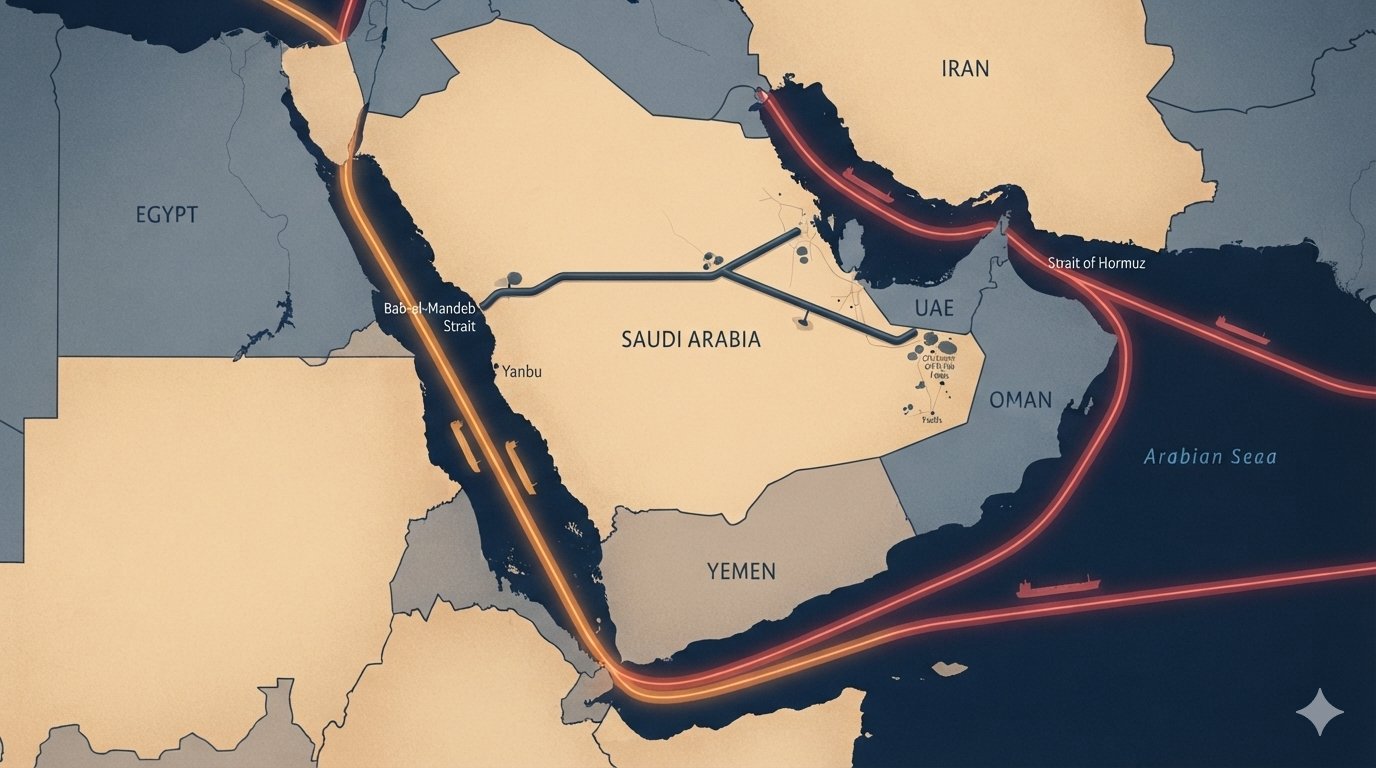
The Strait of Bab-el-Mandeb is a crucial maritime chokepoint connecting the Red Sea to the Gulf of Aden and the Indian Ocean, making its stability vital to global trade and security. According to Al Jazeera, the strait carries approximately 8% of global oil trade and 15% of overall global trade, serving as an essential corridor for commercial shipping and naval vessels traveling between the Mediterranean, the Suez Canal, the Persian Gulf, and Asia. Controlling territory along Yemen’s Red Sea coastline, the Houthis began targeting commercial shipping in 2023 in response to the Israel-Gaza conflict. Coupled with disruptions in the Strait of Hormuz, Saudi Arabia’s East-West pipeline to Yanbu—a pivotal export lifeline—now faces heightened vulnerability.
Understanding why the Houthis escalated attacks in the Red Sea and Bab-el-Mandeb in 2026 rests on three primary factors:
• Protracted Bilateral Hostility: The Houthis have been locked in conflict with Saudi Arabia since 2015, when King Salman bin Abdulaziz intervened against them in the broader regional struggle with Iran. This entrenched hostility makes Saudi-linked shipping a prime target.
• Axis of Resistance Alignment: The Houthis operate within Iran’s “Axis of Resistance,” contributing to Tehran’s broader regional deterrence strategy.
• Retaliation Against Maritime Blockades: The immediate trigger was the resumption of a U.S. blockade near the Strait of Hormuz targeting vessels originating from or passing through Iranian ports. By threatening shipping near Bab-el-Mandeb, the Houthis seek to counter economic and military pressure on their Iranian ally.
Timeline of Houthi Attacks on Saudi Arabia
A prolonged conflict between the Houthi movement in Yemen and Saudi Arabia has reignited following years of relative calm. In the wake of unresolved political grievances, Houthi rebels toppled the government of President Abdrabbuh Mansour Hadi.
• March 2015: Houthis gained control of Yemen’s major cities, forcing President Hadi to flee to Saudi Arabia.
• 2016–2017: The Houthis expanded their reach, targeting deeper locations such as Taif and the outskirts of Riyadh with long-range ballistic missiles.
• September 2019: A massive drone and cruise missile strike hit state-owned Saudi Aramco oil processing facilities in Abqaiq and Khurais, temporarily halving Saudi oil output.
• 2021: Frequent drone swarms targeted southern airports (including Abha and Jazan) alongside major energy terminals across the Kingdom.
• March 2022: A UN-brokered truce slowed cross-border strikes and major ground combat.
• July 2026: The Houthis imposed a maritime embargo, igniting fresh regional tensions.
• September 8, 2026: Nearly 73 people were injured in Houthi attacks on Abha, Jazan, and Najran.
• October 5, 2026: Saudi Arabia launched Operation Yemen Dawn to retake Sanaa, sharply escalating border and regional friction.
• October 6, 2026: Houthi drone and missile strikes severely damaged Abha International Airport, resulting in casualties.
• October 8, 2026: The Saudi-led coalition intercepted ballistic missiles targeting Riyadh and Khamis Mushait, though strikes hit Riyadh’s King Khalid International Airport, killing three Saudi nationals.
• October 10, 2026: Houthi strikes hit Riyadh International Airport, killing 12 people—including an Indian national—and injuring hundreds. [1]
Why Are the Houthis Determined to Target Saudi Arabia?
Three core drivers explain the persistence of this rivalry:
1. Strategic Geography: Located at the southwestern tip of the Arabian Peninsula, Yemen borders the Red Sea to the west, Saudi Arabia to the north, and the Bab-el-Mandeb Strait along its southern coast, making it a critical corridor for international maritime trade. Meanwhile, Saudi Arabia—West Asia’s leading oil producer—sits caught between two vital maritime chokepoints: the Strait of Hormuz to the east and Bab-el-Mandeb to the west. Both actors seek leverage over Middle Eastern security architectures, political alliances, and regional power dynamics.
2. Entrenched Rivalry and Asymmetric Leverage: Following the 2014 Houthi takeover of Sanaa and subsequent civil war, Saudi Arabia became an entrenched adversary. For the Houthis, striking Saudi military bases and critical infrastructure offers a direct way to impose high security and economic costs on a militarily superior neighbor.
3. Convergence with the Wider Regional War: While the Houthis maintain independent objectives, their strategic interests frequently overlap with Iran’s during the U.S.-Israeli conflict with Tehran. As Iran maintains a blockade on the Strait of Hormuz, Houthi threats against Bab-el-Mandeb simultaneously pressure both maritime chokepoints, severely straining Saudi Arabia’s economic stability.
Economic Implications of Houthi Attacks on Saudi Arabia
According to a report by the Arab Gulf States Institute, Saudi Arabia faces slowing economic growth and major trade disruptions, though domestic inflation impacts remain relatively contained. Both import and export volumes have dropped as the broader regional conflict disrupts shipping through the Strait of Hormuz.
Escalating attacks on Saudi territory have placed de facto ruler Crown Prince Mohammed bin Salman under mounting pressure to intensify a war the Kingdom had been actively trying to exit. International Monetary Fund Managing Director Kristalina Georgieva warned that attacks on Saudi Arabia could affect people “everywhere,” as conflict in the energy-rich Gulf drives up crude oil prices, shipping insurance, and supply chain costs worldwide.
These strikes directly threaten the ambitions of Vision 2030, Riyadh’s national transformation blueprint designed to diversify the economy away from oil by leveraging the country’s cultural heritage and geographic position. Achieving Vision 2030’s goals—creating jobs and expanding tourism, logistics, and giga-projects—requires investor confidence, open trade routes, and domestic security. Persistent missile and drone threats undermine that foundation.
Continuous attacks have also severely disrupted international aviation. Following repeated strikes on Saudi airports, airlines suspended services across the Kingdom:
• Turkish carriers halted flights between Istanbul and Riyadh.
• Etihad Airways canceled selected services connecting Abu Dhabi with Riyadh, Jeddah, and Dammam.
• Qatar Airways, Air India, IndiGo, and Gulf Air temporarily suspended flight operations in the aftermath of the strikes.
Through these disruptions, the Houthis aim to weaken the Saudi economy by choking off tourism and foreign capital inflows.
The Need for a Lasting Regional Settlement
The Saudi-Houthi dispute is far more than a proxy rivalry between Riyadh and Tehran; it reflects deep-seated political grievances within Yemen alongside the vulnerability of vital global shipping lanes. Houthi strikes on energy infrastructure and commercial shipping demonstrate how regional instability spills beyond the battlefield to disrupt global trade and threaten Saudi Arabia’s Vision 2030 transformation. For Riyadh, national security requires defending not only its physical borders, but also the economic stability essential to its domestic reforms.
At the same time, viewing the conflict purely as an Iranian proxy war obscures the Houthis’ independent political agenda. Sustainable security cannot be achieved by military force alone; Saudi Arabia must pair defensive capabilities with persistent diplomacy. Securing the Kingdom’s future and safeguarding international maritime corridors ultimately depends on negotiating a durable political settlement in Yemen—ensuring that domestic instability in Yemen no longer threatens the wider region.
References
• United Nations Department of Political and Peacebuilding Affairs (DPPA). Special Envoy for Yemen Fact Sheet. un.org
• Sana’a Center for Strategic Studies. Policy Research Publications. sanaacenter.org
• Brandt, Marieke. Tribes and Politics in Yemen: A History of the Houthi Conflict. Oxford University Press, 2017. Print ISBN: 9780190673598 | Online ISBN: 9780190872649. oup.com
• Saudi Aramco. Incidents at Abqaiq and Khurais. September 2019. aramco.com
• UN Trade and Development (UNCTAD). Unprecedented Shipping Disruptions Raise Risk to Global Trade, UNCTAD Warns. February 2024. unctad.org
• UN Trade and Development (UNCTAD). Red Sea Crisis and Implications for Trade Facilitation in Africa. unctad.org
• The Hindu. “With Houthi Blockade on Saudi Arabia, Bab-el-Mandeb Returns to Centre Stage.” thehindu.com
• Arab News. “Timeline: Houthi Attacks on Saudi Arabia.” arabnews.com
• Al Jazeera. “Houthi Missile Attack Targets Saudi Capital Riyadh for Third Day in a Row.” October 12, 2026. aljazeera.com
• Lott, Alexander. “Maritime Security Threats and the Passage Regime in the Bab el-Mandeb.”
• Khadduri, Majid. The Gulf War.
• Azmi, Rafiullah. Conflict in the Gulf.
• BBC News. bbc.com
About the Authors
Yumna Samim is an International Relations researcher pursuing an MA in International Relations – West Asian Studies at Jamia Millia Islamia, New Delhi. She has worked with Primus Partners, Palakiya Foundation, and BLOC, and has contributed to policy research, parliamentary analysis, and climate-focused writing.
Habiba Fatima is a Master’s student in International Studies at Jamia Millia Islamia. She is a research intern at the Sir Syed Center of International Relations and Risk Analysis and has previously interned at AICTE. Her research and writing interests lie in geopolitics, strategic technology and affairs, and the Arab world.
