
Water Conflict and Cooperation in West Asia
Dr Ghazzala Shabbana
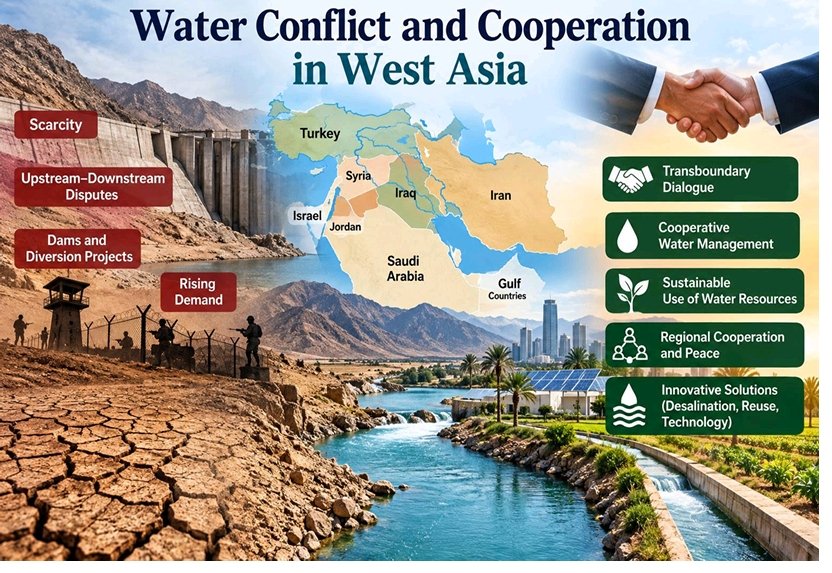
Water is a critical requirement for life, economic development, farming, power production and the environment. Is is an important political and strategic issue in West Asia. Many parts of the area are arid or semi-arid, receiving variable and unpredictable rainfall, high evapotranspiration and limited availability of renewable freshwater. At the same time, population growth, urbanisation, and agricultural development have increased the demand for water. The outcome is a continual disparity between water supply and water demand.
Substantial amounts of freshwater flowing across international boundaries further complicate the problem. The Euphrates and Tigris rivers flow through Turkey, Syria, and Iraq; the Jordan and Yarmouk systems through Israel, Jordan, Syria, Lebanon, and the Palestinian territories; and the Orontes River flows through Lebanon, Syria, and Turkey. This means that one jurisdiction’ The transboundary nature of these rivers establishes an inherent political connection between the two regions upstream and downstream.
The geographical advantage for countries upstream is that they can construct dams, reservoirs, and irrigation projects before water reaches the downstream countries. The countries that are downstream, on the other hand, depend on water flowing into their area. This spatial imbalance can convert to political imbalance if the economic or military power of the upstream countries is greater. The political dynamics in the Euphrates-Tigris basin are a particularly clear example. The Southeastern Anatolia Project (GAP) in Turkey was designed to improve the power generation and agricultural development in the southeast of the country.
In Turkey, the project was considered an important national development initiative. However, Syria and Iraq were worried that full control of the Euphrates and Tigris by the Turks would either reduce or alter the flow of water available to them. The Arab-Israeli conflict has been a complex rivalry concerning the Jordan River and its affluents, exacerbating political strains in the 1950s and 1960s. The history of the Jordan Basin, however, shows that water is not necessarily a source of conflict.
The 1994 Israel-Jordan Peace Treaty included water management and cooperation agreements. This is a paradoxical situation that is crucial to the study of water politics in West Asia. If water scarcity unavoidably led to conflict, elucidating collaboration would be challenging. History suggests that lack of supply affects political institutions, power, economic motives, national security and diplomacy. The piece argues that water conflicts do not only stem from hard water scarcity.
It arises from the interplay of scarcity and imbalanced power, one-sided advancement, fragile institutions, and conflicting national priorities. Countries recognize interdependence and put in place systems for information sharing, negotiation and fair benefit sharing and collaboration is possible. West Asia needs to move away from the outdated perspective of viewing water as a commodity to be divided among competing states.
A better approach is to view the river basin as a unified whole, where water, energy, agriculture, environment and economic growth are all connected. Water security in West Asia depends on the ability of countries to turn water conflict into an operational agreement.
This change can be achieved by various cooperative river basin organizations, information sharing, optimization of irrigation systems, wastewater recycling, ecological protection, equitable sharing of benefits and effective dispute resolution processes.Water can also be a key tool in regionally building peace and discussion, regardless of the fact that it can be a catalyst for insecurity.
(Writer is an Assistant Professor, Centre for West Asian Studies, Jamia Millia Islamia, New Delhi)
