
Rising Heat Costs Jharkhand ₹1.76 Lakh Crore in Labour Productivity; Future Losses Projected to Hit ₹9.35 Lakh Crore
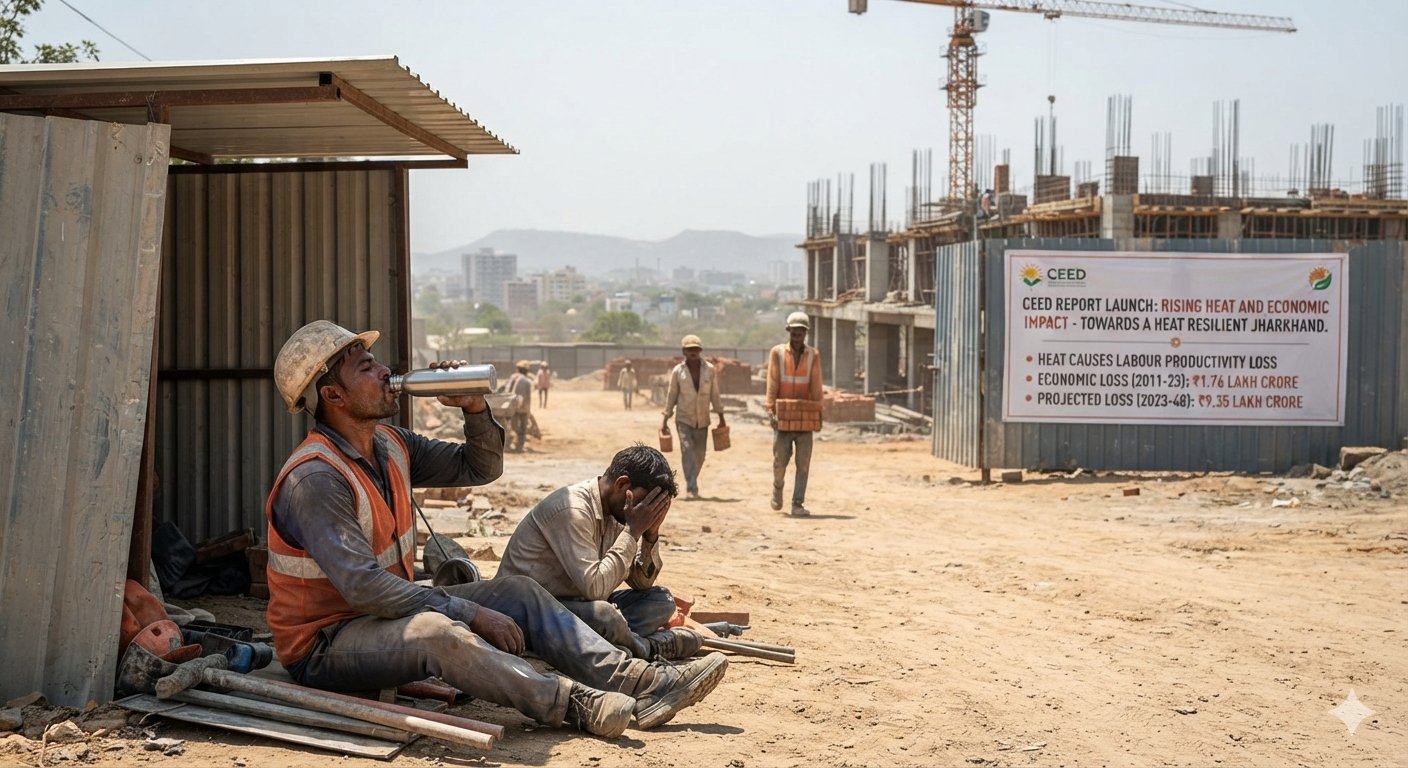
RANCHI: Heat exposure is no longer just a public health or climate concern for Jharkhand; it has evolved into a severe economic threat driven by massive labour-productivity losses. A new report by the Center for Environment and Energy Development (CEED) reveals that heat stress cost the state an estimated cumulative economic loss of ₹1.76 lakh crore between 2011–12 and 2022–23, equivalent to 8.0% of Jharkhand’s cumulative Gross State Value Added (GSVA).
The report was officially released during a high-level roundtable discussion titled “Rising Heat and Economic Impact: Towards a Heat Resilient Jharkhand.” The event brought together senior government officials, industry leaders, MSME representatives, labour unions, and civil society organizations to address the growing socio-economic risks of climate change.
The Invisible Toll on Key Sectors
Unlike floods or storms, extreme heat does not physically destroy infrastructure, roads, or machinery. Instead, its economic impact accumulates silently through reduced working hours, lower human productivity, construction delays, and drop-offs in agricultural output—costs that largely go unrecorded in conventional economic metrics.
The report points out that outdoor, open, and unshaded environments bear the brunt of these losses. Between 2011–12 and 2022–23, the most heavily impacted industries included:
• Construction: Accounted for the highest share of cumulative losses at 25%
• Agriculture, Forestry, and Fishing: Linked to 11% of losses
• Transport, Storage, and Communication: Responsible for 10%
• Manufacturing: Contributed to 8%
• Mining and Quarrying: Accounted for 7%
Combined, labour-intensive sectors like construction, agriculture, manufacturing, and mining made up nearly 70% of the total economic losses. Out of the total ₹1.76 lakh crore hit, ₹0.87 lakh crore (3.97% of GSVA) constituted direct economic losses, while the rest rippled out as indirect, economy-wide shocks.
Alarming Future Projections
The financial burden is expected to worsen significantly. CEED’s forward-looking data models project that cumulative economic losses could spiral to ₹9.35 lakh crore during the period from 2023–24 to 2047–48, consuming 10.31% of the state’s projected GSVA. This future forecast includes an estimated ₹4.70 lakh crore in direct economic losses (5.18% of projected GSVA).
Dr. Harishwar Dayal, Associate Professor of Economics at St. Xavier’s College, Ranchi, highlighted the human cost behind these numbers, noting that the state’s vast outdoor workforce faces lower household incomes and limited cooling amenities, which exacerbates vulnerability among marginalized livelihood groups.
The Path Toward Resilience
Government and policy experts at the roundtable emphasized that mitigating heat risk requires urgent, structural intervention. Mr. Ravi Ranjan (IFS), State Nodal Officer for Climate Change, affirmed that the state’s climate action plan is already deploying regional relief programs. He advocated for community-driven steps, including the protection of urban-rural green covers, the adoption of cool roofing materials, and the rapid expansion of shaded public squares.
Ramapati Kumar, CEO of CEED, stressed the financial necessity of integrating heat risks directly into state and district-level budgets. Moving forward, the consultation—moderated by Ms. Shrishty Pallav (Director of Policy and Partnership, CEED)—outlined critical action areas. These include updating building regulations, mandating heat-safety protocols for industrial approvals, introducing heat-resilient agriculture in high-risk zones, restructuring public work calendars (such as MGNREGA), and ensuring mandatory shade, rest periods, and hydration at all active worksites.
