
When AI Becomes a Weapon: The Growing Threat of Deepfakes Against Women
By Vartika Lal
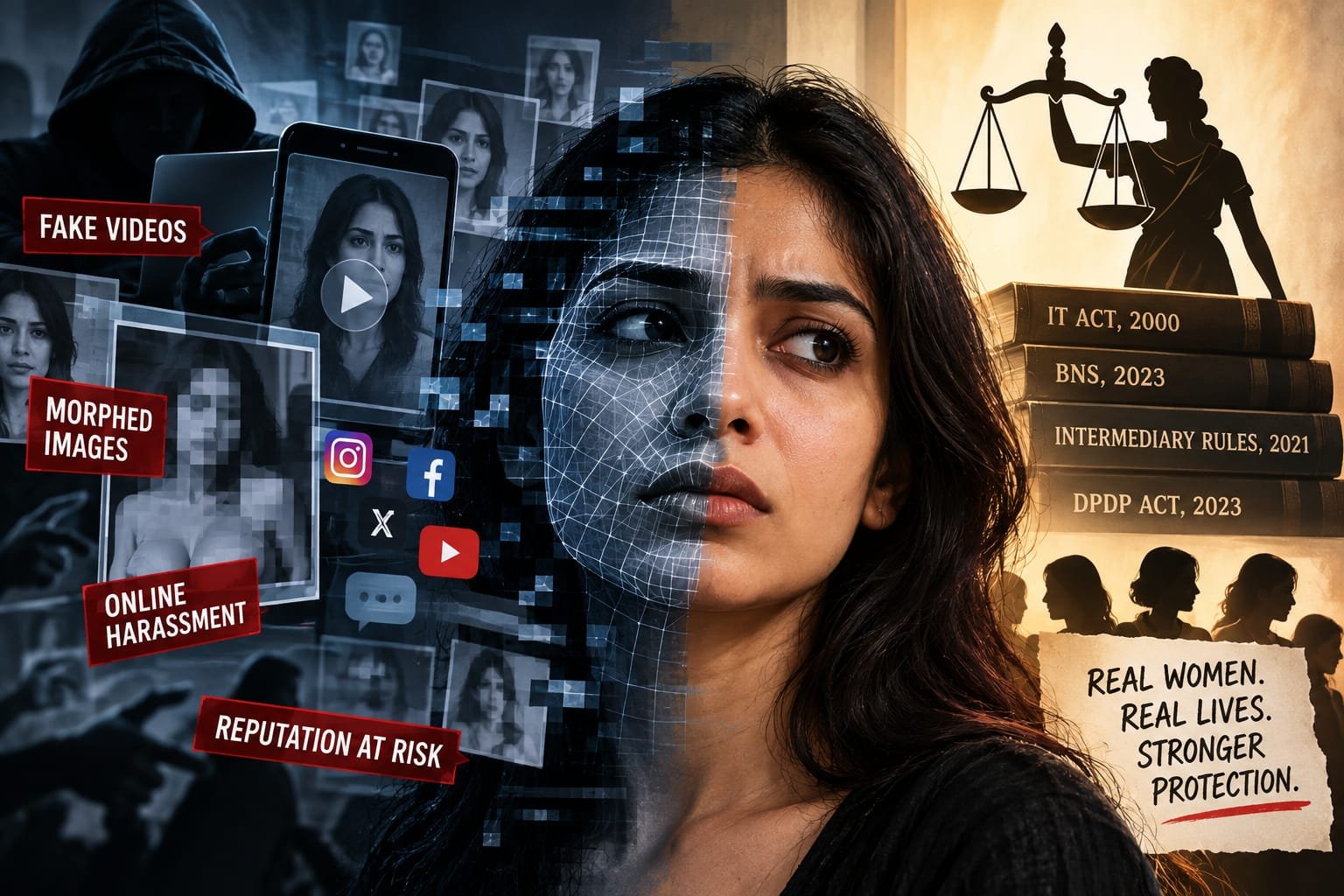
Artificial Intelligence is becoming a part of our everyday lives. We use it to write, create pictures, make videos, translate languages and even imitate voices. AI has made many things easier and faster.
But like every powerful technology, AI can also be misused. One of the most worrying examples is deepfake technology. A deepfake is a fake photo, video or audio created or changed using artificial intelligence. It can make a person appear to say or do something that they never actually said or did. Sometimes, it can be almost impossible for an ordinary person to tell whether the content is real or fake.
For women, this technology has created a particularly serious problem. An ordinary photograph of a woman taken from Instagram, Facebook or another public platform can be manipulated and turned into a sexually explicit image or video. Her face can be placed on another person’s body. Her voice can be copied. A completely fake video can be created and then shared with thousands of people.
The woman may never have taken such a photograph or video. She may never have consented to it. Yet she is the one who has to face the consequences. This is not simply a problem of technology. It is a form of digital violence against women. When a fake video creates real harm The most dangerous thing about a deepfake is that although the content is fake, the damage is real. A woman may lose her reputation. Her family may question her. Her friends may distance themselves. She may face harassment at work or college. She may receive threats or become a victim of blackmail.
In some cases, the person creating the fake content may threaten to release it unless the woman pays money or follows their demands. The internet makes the situation even more difficult.
Once something is uploaded, it can be downloaded, copied and shared again. Even if the original post is removed, another person may already have saved it. This means that a victim may spend days, weeks or even months trying to remove the same content from different platforms. The technology may create the fake in seconds, but the victim may have to deal with its consequences for years.
India already has laws to deal with many forms of online abuse
It is sometimes said that India has no law to deal with deepfakes. That is not completely correct.
India already has several laws that can be used against different forms of deepfake abuse. The Information Technology Act, 2000 contains provisions dealing with privacy violations and obscene or sexually explicit material shared electronically. Sections 66E, 67 and 67A can become relevant depending on the nature of the content and the circumstances of the case.
The Bharatiya Nyaya Sanhita, 2023, which replaced the Indian Penal Code, also contains provisions that may apply. These include provisions dealing with voyeurism, stalking, intrusion into a woman’s privacy and defamation.
For example, the law recognises online monitoring as part of stalking. This is important because online harassment is often not a single incident. A person may repeatedly follow, contact, threaten or monitor a woman online.So, the law does provide several possible remedies. The problem is that these remedies are spread across different laws. There is no single law that deals with every aspect of a deepfake case.
Social-media platforms also have responsibilities
The role of social-media platforms is very important. If a woman finds a fake intimate photograph or video of herself online, she should not have to wait for months for it to be removed. The Information Technology (Intermediary Guidelines and Digital Media Ethics Code) Rules, 2021 provide a mechanism for dealing with certain types of harmful content.
The rules cover complaints involving content showing private areas, nudity, sexual acts and electronic impersonation, including artificially morphed images. The recent changes have made the system faster. For certain complaints involving intimate or impersonation-related content, platforms are required to act within two hours of receiving the complaint. This is an important step.
In cases involving sexual deepfakes, speed matters. Every hour that the content remains online increases the possibility that someone will download and share it. The government has also recently strengthened the rules dealing with synthetically generated information, including certain unlawful AI-generated content. These changes show that Indian law is beginning to recognise that AI-generated content needs special attention. But taking down one post is not enough. Imagine a woman finds a fake video of herself on a social-media platform.
She complains. The platform removes it. But before the removal, hundreds of people may have downloaded it. Someone may upload it to another website. Another person may share it in a private messaging group.
The victim is then forced to start the process again. This is one of the biggest challenges.
The system should not only remove the first post. It should also try to stop the same harmful content from being repeatedly uploaded. Technology can help here. Platforms can use digital fingerprints or similar methods to identify copies of content that has already been confirmed as unlawful.Of course, such systems must have safeguards so that legitimate content is not wrongly removed.
Another problem: How do we prove that it is a deepfake?
This is one of the most difficult questions. Suppose a woman says: “This video is fake. I was never there.” How does she prove it? Deepfake technology is becoming increasingly sophisticated. A fake video can look very real. At the same time, AI detection tools are not perfect. Sometimes they can make mistakes.
Therefore, investigators and courts cannot depend only on an AI detector. They may need to examine the original files, metadata, devices, accounts, messages and other digital evidence. Technical experts may also be required to determine whether the content has been manipulated.
The Bharatiya Sakshya Adhiniyam, 2023 provides the legal framework for dealing with electronic and digital evidence. For victims, one simple thing is very important: save the evidence.
Take screenshots. Save the link. Keep messages and emails. Record the date and time. Do not immediately delete everything before preserving evidence.
What about a woman’s photograph or personal data?
There is another important issue.A person’s photograph, video, voice or other information may be used to create a deepfake. The Digital Personal Data Protection Act, 2023 provides a broader framework for the processing of digital personal data and consent. But it is important to understand that this law is not a complete answer to the deepfake problem.
A privacy law can address certain issues involving personal data, but it does not by itself solve the problem of someone creating and spreading a fake sexual video of a woman. This is why different areas of law need to work together. The law has to keep up with technology
The biggest challenge is that technology is moving faster than legislation. When many of India’s existing cyber laws were created, generative AI tools did not exist in their present form.
Today, a person with an internet connection can access tools capable of creating highly realistic images, videos and voices.
This does not mean that India needs to ban AI.AI has many useful applications. It can help in education, healthcare, research, entertainment and business.The problem is not AI itself.
The problem is using AI to harm another person.There is a huge difference between creating a fictional AI character and creating a fake sexual video of a real woman without her permission.
The law should therefore focus on consent, harm and intention.
What should be done?
India already has several legal provisions, but there is a need for a more connected and victim-friendly system. First, there should be a clear legal definition of harmful deepfake content.
Second, there should be stronger and clearer legal protection against non-consensual sexual deepfakes. Third, victims should have one simple way to report such content instead of having to approach several authorities and platforms separately. Fourth, platforms should have effective systems to prevent the same unlawful content from being uploaded repeatedly. Fifth, police officers and cybercrime investigators need proper training in AI and digital forensics. Sixth, courts and prosecutors also need to understand how deepfake technology works. A victim should not be expected to explain complicated technology every time she seeks help.Finally, victims need support beyond the courtroom. They may need legal assistance, counselling and help in protecting their personal and professional lives.
Women need digital freedom, not digital fear
Women’s empowerment in today’s world is not limited to education, employment or financial independence. It also includes digital freedom. Women should be able to use social media without constantly worrying that an ordinary photograph could be turned into something harmful.
They should be able to participate in public life without fear of being digitally humiliated.
They should be able to report abuse and receive a quick response.And most importantly, a woman should not have to spend her life proving that something never happened simply because someone used AI to make it look real.
Deepfakes have changed the meaning of digital abuse. A fake image can create real humiliation. A fake video can cause real damage. A fake voice can create real confusion. The challenge before us is therefore not to stop technological progress, but to make sure that technological progress does not come at the cost of human dignity.
India has already started taking steps in this direction through its cyber laws and intermediary rules. The recent focus on AI-generated and synthetically generated content is another important development. But laws alone will not be enough. Technology companies, social-media platforms, police authorities, courts, educational institutions and society must all play a role. Because when a woman’s identity is misused online, the issue is not merely about a fake picture or video.
It is about her privacy, dignity, reputation, safety and right to control her own identity.
And in the age of AI, protecting those rights must become an essential part of protecting women.
Writer is a Researcher – National University of Study and Research in law (NUSRL) Ranchi
LLM – Hidayatullah National Law University, Raipur
BA LLB – Himachal Pradesh National Law University Shimla
