
The Mockery of India’s Electoral Democracy: A Call for Opposition Reckoning
By Mithilesh Kumar Jha, New Delhi
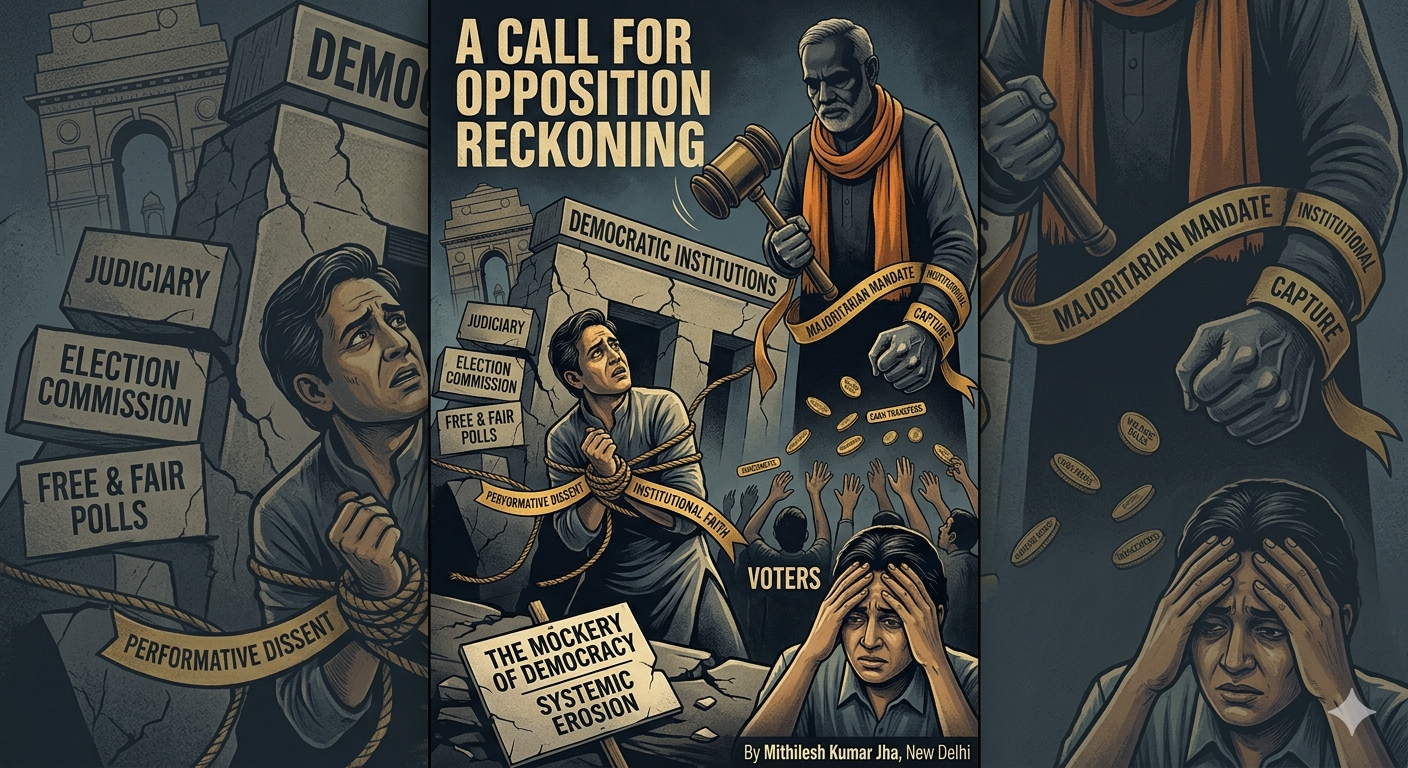
As I sit in New Delhi, witnessing the unfolding drama of recent electoral exercises, a profound sense of anguish grips me. The institutions that once formed the bedrock of Indian democracy — the Election Commission of India (ECI), the judiciary, and the very idea of free and fair polls — appear to be in accelerated decay. What pains me most is not merely the actions of the ruling dispensation, but the complicity, through inaction and misplaced faith, of the opposition parties. This is the lament of a citizen who has watched the systematic erosion of constitutional values.
Electoral Bribery on Full Display
The recent polls, including the Bihar Assembly elections last year, have exposed blatant manipulations that mock the democratic process. In Bihar, the ruling NDA government’s direct cash transfers of ₹10,000 to women voters, disbursed around the time of election announcements and even during the campaign period, were widely criticised as state-sponsored bribery aimed at influencing a vulnerable electorate in a state grappling with poverty. Similar patterns of inducement have surfaced elsewhere. In West Bengal, accounts of special arrangements — to and fro AC train tickets and payments reportedly around ₹5,000 per vote — to ferry Bengali migrants from across India to cast ballots further underscore how the system is being gamed. And BJP and NDA are definitely not the only ones indulging in such practices of poll bribery. More or less, all political parties across the spectrum attempt to use this vote and voter manipulation tools to the best of their abilities, as and when they get any such opportunity. These are not isolated anomalies but symptoms of a deeper malaise where electoral outcomes are engineered through inducement rather than persuasion. The Special Intensive Revision (SIR) exercises of electoral rolls have themselves been widely criticised as tools that distort representation, often selectively. Such practices erode public trust. When muscle power, money, transport, and targeted welfare doles timed with polls become the currency of politics, the informed citizenry — the very soul of democracy — feels disenfranchised.
Institutional Capture by the Ruling Dispensation
The deeper rot lies in institutional capture. The Bharatiya Janata Party (BJP) and its ideological fountainhead, the Rashtriya Swayamsevak Sangh (RSS), have long been transparent about their priorities. They do not venerate the constitutional trinity of liberty, equality, and justice in the liberal sense. Their worldview privileges a majoritarian cultural narrative — Hindutva, selective interpretations of tradition, history, and identity — often laced with communal polarisation. Through relentless propaganda, they have cultivated a dedicated base that prioritises emotional mobilisation over rational discourse. This strategy has proven electorally potent, allowing them to consolidate power and then reshape institutions to their advantage.The judiciary’s compromised state is particularly alarming. Post-retirement appointments, incentives, and the opaque collegium system — itself a form of institutionalised nepotism — have made higher courts vulnerable to influence. The removal of the Chief Justice of India from the selection panel for Election Commissioners, replaced by a Cabinet Minister, exemplifies executive overreach that tilts the scales. When the ECI itself faces allegations of partisanship and the courts appear reluctant to intervene robustly, the checks and balances envisioned by the Constitution falter. It is understandable, although deplorable, that a force ideologically sceptical of liberal democracy would pursue such control. Power, once gained through elections, is being used to ensure its perpetual hold “by hook or by crook.”
The Opposition’s Complicity
What is less understandable — and far more culpable — is the role of the opposition. Leaders like Rahul Gandhi of the Congress, Mamata Banerjee of the Trinamool Congress, and Arvind Kejriwal of the Aam Aadmi Party repeatedly profess faith in the very system they decry as rigged. They approach the judiciary with petitions, participate in elections under rules they call manipulated, and issue statements that ultimately legitimise the institutions even as they criticise specific outcomes. This performative dissent without systemic rejection has been devastating. By treating the ECI and judiciary as salvageable through incremental appeals, the opposition provides a veneer of normalcy. It signals to the public and the world that Indian democracy is functioning, albeit imperfectly. This aids the ruling party’s narrative. When opposition leaders win in some states, e.g. the win of UDF in Keralam in May 2026, they hail the “resilience of democracy”; when they lose, they cry foul but return for the next round. This inconsistency weakens their moral authority.The erosion of institutions is not solely the BJP’s achievement; it is enabled by an opposition unwilling to confront the existential threat head-on.
A Call for Radical Resistance
Imagine, instead, a unified opposition declaring in one voice: We have lost faith in the current electoral and judicial framework due to its capture. We will not legitimise this farce through participation until systemic reforms — independent appointment processes, transparent funding, strict enforcement against inducements, and accountability for institutional bias — are guaranteed. Such a boycott, coupled with mass mobilisation for a “second freedom movement,” would force a national reckoning. It would signal that democracy’s guardians refuse to play a rigged game. Critics will call this undemocratic or destabilising. But clinging to a hollow shell of democracy is more dangerous. History shows that institutions decay not just from external assault but from internal abdication. The opposition’s failure to unite — hampered by ego, regional ambitions, and ideological fragmentation — has been the greatest gift to the forces of centralisation. Rahul Gandhi’s episodic marches and Mamata Banerjee’s fiery rhetoric achieve little without coordinated resolve.
The Path Forward
The consequences of continued drift are dire. An unaccountable executive, a pliant judiciary, a polarised electorate, and compromised polls risk transforming India into a majoritarian electoral autocracy. The “bhakts” — the unquestioning faithful — provide the critical mass, sustained by welfare doles, identity politics, and fear of the “other.” Informed public opinion, constitutional ethics, and evidence-based discourse matter little in this ecosystem. This is not a counsel for violence or anarchy, but for principled non-cooperation with a degraded system. Civil disobedience, nationwide protests, intellectual mobilisation, and refusal to participate in sham processes could reclaim agency. The opposition must move beyond seat-sharing arithmetic to a deeper ideological and institutional critique. They must articulate a positive vision of renewed constitutionalism — one that upholds justice, liberty, and equality without appeasement or majoritarianism. As someone pained by this spectacle, I urge opposition leaders to introspect. Their silence or half-hearted resistance makes them co-architects of institutional demise. The BJP acts according to its convictions; the opposition betrays its own stated ideals by normalising the abnormal. India’s democracy deserves better. The Constitution was born from a freedom movement that challenged an unjust order. Perhaps another such awakening is needed — not against foreign rule, but against the internal subversion of our republican ideals. Only through bold, unified action can we arrest the decay and restore institutions worthy of a great civilisation. The time for half-measures is over. The choice before the opposition is clear: legitimise the erosion or lead the resistance. India’s future hangs in the balance.
Mithilesh Kumar Jha is a concerned citizen and observer of Indian politics based in New Delhi.
