
Light Fidelity (Li-Fi): A visible light communication technology
Dr. Satchi Singh
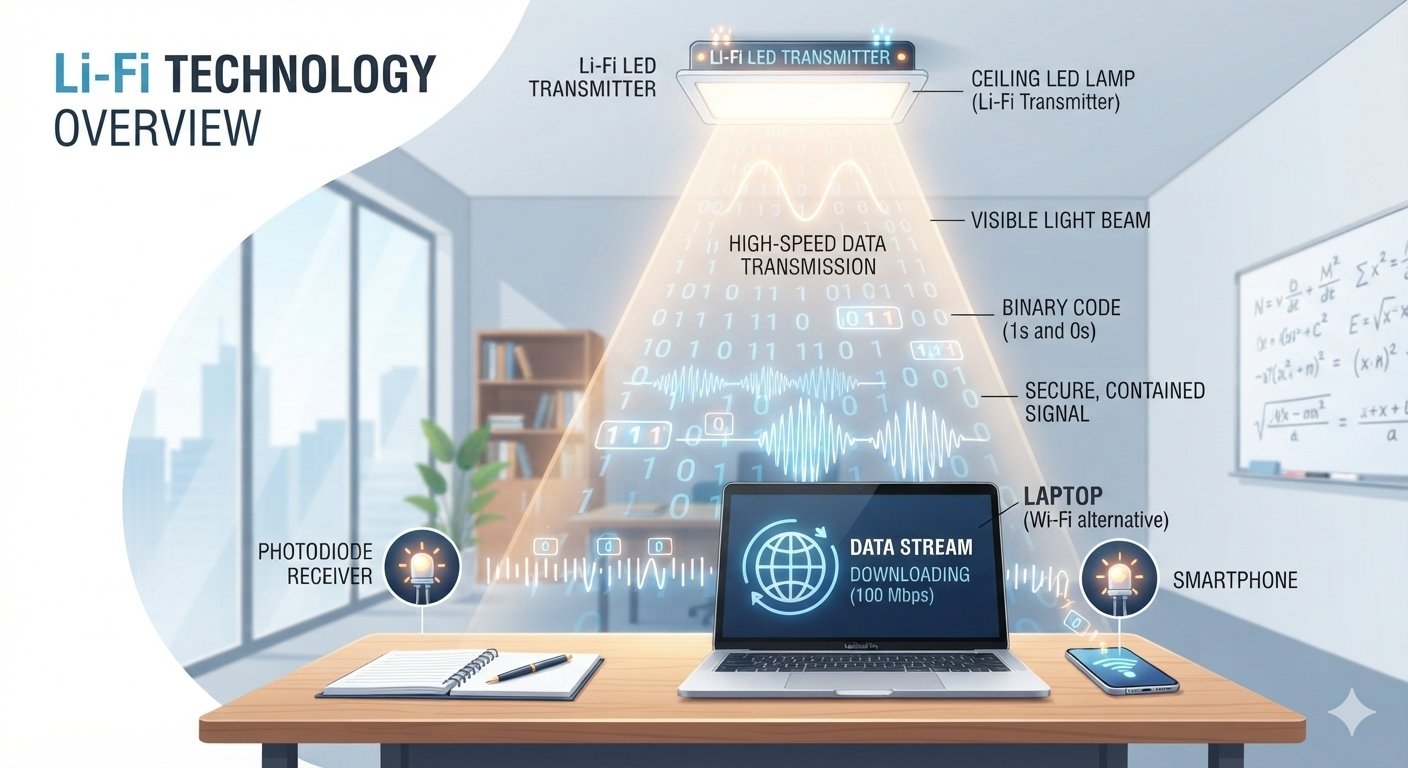
Today we are living in the era of mobile wireless communication technology. Sending and receiving data in the form of text, images, audio and video is frequent and has become an integral part of our everyday life. Life can’t be imagined without internet and Wi-Fi. Growing digital life around us has become prime governing parameter for all human activities ranging from marketing, education to health monitoring. Continuously increasing demand for higher data transmission speed has kept pushing for next generation technologies like 3G, 4G, 5G (speed 10 GBPS i.e 1010 Hz) and now being established the 6G (1000 GBPS i.e 1012 Hz). Visible light hold potential for extremely high switching speed in terms of its frequency being equal to 1015 Hz i.e nearly 1000 times the 6G communication speed being aimed.
This technology was first coined by a German physicist, Harald Haas in 2011 in his TED talk on visible light communication (VLC). It is a wireless optical networking technology which uses light emitting diodes (LEDs) for transmission of data. From the vast range of frequencies in the electromagnetic spectrum, it uses visible band unlike radio frequencies used in a Wi-Fi network deriving it’s name visible light communication technology. It helps in delivering high-speed communication and complies with the IEEE standards IEEE802.15.7., it is a high-speed bidirectional and fully networked wireless communication technology-based standards similar to Wi-Fi’s IEEE802.11.
It is a new form of wireless technology currently suitable for short distances upto 10 meters. It is ideal for high density wireless data coverage in confined area viz., classroom, seminar hall, especially useful for applications in areas where radio interference issues are of concern, so that the two technologies Wi-Fi and Li-Fi can be considered as complimentary. Moreover, Li-Fi provides better bandwidth, efficiency, connectivity and security than WiFi and has achieved high speed larger than 1Gbps as compared to typical 100 Mbps delivered through Wi-Fi. This puts Li-Fi in a unique position of extremely fast wireless communication over short distances.
It is fully networked and mobile. The experience of using Li-Fi is similar to Wi-Fi but offers a range of advantages. It uses visible light rather than radio frequencies to transmit data so has a wide bandwidth and less traffic. A number of frequencies in the visible range can be transmitted together through Li-Fi techniques over same hardware through Wavelength Division Multiplexing (WDM).
.
Architecture of Li-Fi
It uses fast pulses of light to transmit information in wireless medium. Fig. 1 Shows the schematic of working of Li-Fi technology for data transmission. It is basically comprised of two components a high brightness white LED which acts as transmission source and a silicon photodiode with good response to visible light as the receiving elements. The Li-Fi transmitter system comprises of four primary subassemblies. Bulb, RF power amplifier circuit (PA) printed circuit board (PCB) and enclosure.
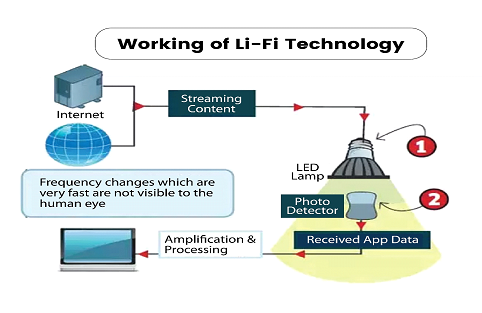
Fig. 1 Shows the schematic of working of Li-Fi technology for data transmission which uses simple hardware like LED Lamp and photodetectors.
To generate a new data stream, data can be encoded in the light by varying the flickering rate of the LED. Switching ON a LED is a logical ‘1’, switching it OFF is a logical ‘0’. By varying the rate at which the LEDs flicker on and off, information can be encoded in the light to different combinations of 1s and 0s. The flickering rate is millions of times per second therefore it’s impossible for human eye to detect this frequency. High speed LEDs with the help of various multiplexing technique can achieve 100 Mbps. 10 Gbps can be achieved via parallel data transmission using an array of LED lights with each LED transmitting a different data stream. A microcontroller is used to manage different lamp functions. A radio frequency RF signal is generated by the power amplifier and is directed into the electric field of the bulb. The contents of the bulb will get vaporized into a plasma state at the bulb’s center. It will produce an intense source of light. The unique combination of high temperature plasma and digitally controlled solid state electronics results in economically produced family of lamps scalable in package from 3,000 to over 100,000 lumens.
Comparison between Wi-Fi and Li-Fi
Both Wi-Fi and Li-Fi provides wireless internet access to users. Wi-Fi uses radio waves for transmission whereas Li-Fi utilizes visible light waves (VLC). VLC uses the visible light between 400 THz (780 nm) and 800 THz (375 nm) as medium which are less dangerous for high power applications and also human can easily perceive it and protect themselves from the harmful effect. Radio waves are expensive due to spectrum charges and less secure due to the interference. The other ranges of electromagnetic radiations viz., Gamma rays, UV and X-rays have adverse effects on human health on direct exposure. Further IR radiations due to safety regulations can only be used with low power. VLC is free from all these shortcomings and has the potential to provide larger bandwidth and also promising future in the communication field.
Advantages of Li-Fi
Energy consumption can be minimized with the use of LED illumination due to their high quantum efficiencies. LED based illumination is already being used in homes, offices and mall etc due to their low energy consumption and high efficiency. Combination of low interference, high bandwidth and high-intensity output help Li-Fi provide high data rates i.e., 1 Gbps or even beyond. It requires limited number of components for its implementation, but also uses only a negligible additional power for the data transmission. Most importantly Li-Fi is a secured network since light cannot pass through opaque structures, Li-Fi internet is available only to the users within a confined area and cannot be intercepted and misused outside the area under operation.
Limitations of Li-Fi
Internet cannot be accessed without a light source. This could limit the locations and situations in which Li-Fi could be used. It requires a near or a perfect line-of-sight to transmit data. Opaque obstacles on pathways can affect data transmission. Natural light, sunlight and normal electric light can affect the data transmission speed. It works only in a short range and is yet to be developed for mass scale adoption.
Applications
It holds the potential for public internet access through existing lighting technology of LEDs. Places where Wi-Fi technology lacks its presence like aircrafts and hospitals (OT), power plants and various other areas where electromagnetic (radio) interference is of great concern for safety and security of equipment and people, Li-Fi can be a solution. Li-Fi can help transform street lamps to Li-Fi connecting points to transfer data. As a result of this, it is possible to access internet at any public place and street. Also, in operation theaters which do not allow Wi-Fi due to radiation concerns and blockage of signals for monitoring equipment Li-Fi can be very useful and would extend connectivity of large volume of medical data. One can access internet and also control medical equipment. This will be beneficial for conducting robotic surgeries and other automated procedures. In aircrafts Wi-Fi interfere with the navigation systems of the pilots. In aircrafts Li-Fi can be used for data transmission. Li-Fi can easily provide high speed internet via every light source such as overhead reading bulb etc., present inside the airplane.
Author
The author Dr. Satchi Singh is a researcher in the field of optics and photonics. She has obtained Ph.D in Photonics from IIT Guwahati and have taught at University of Delhi and Central University of Jharkhand.
