
The West Asian Turbulence: How a Hyper-Fragile Gulf Threatens Global Stability
By: Dr Ghazzala Shabbana, Assistant Professor, Centre for West Asian Studies, Jamia Millia Islamia, New Delhi.
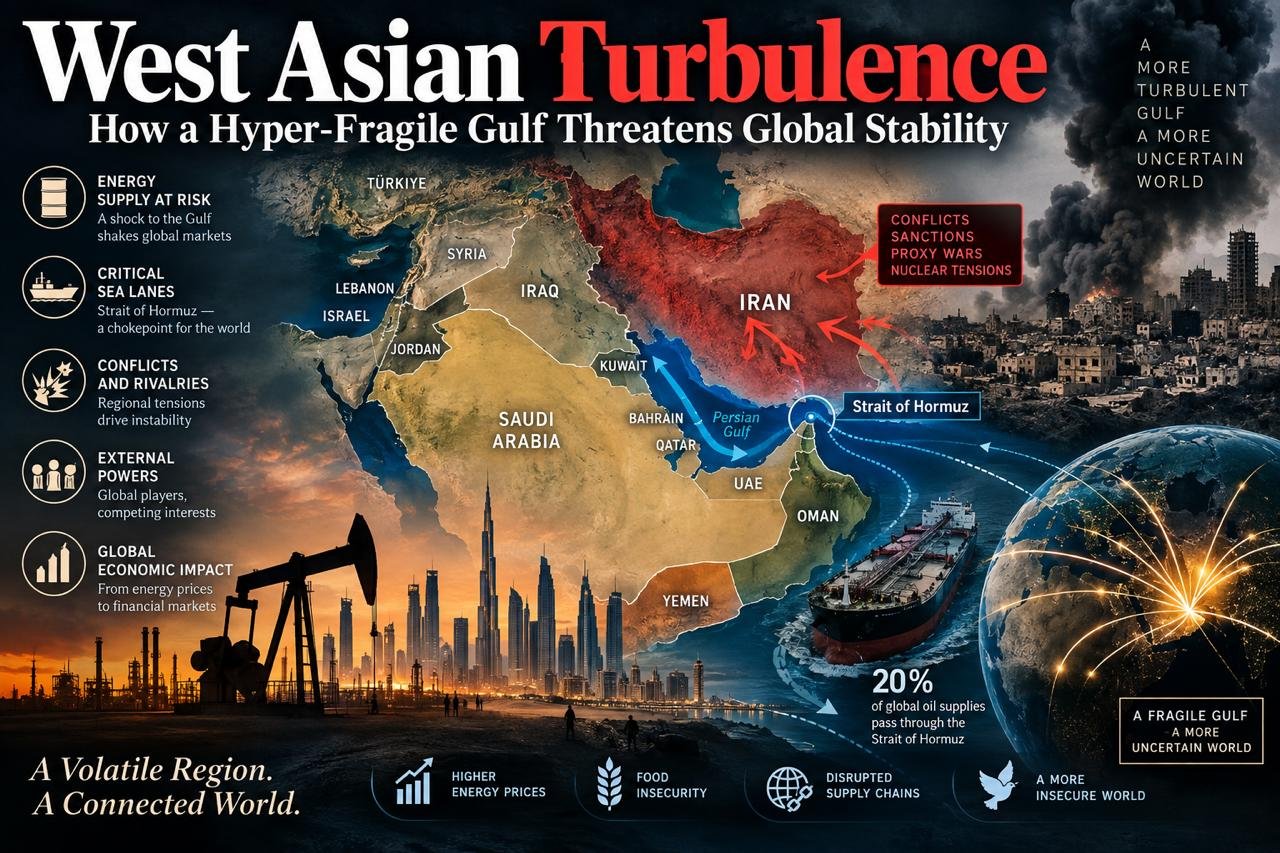
What began as a localized, shadow conflict in West Asia has transformed into an expansive multi-front war that has shattered the regional security structure and plunged the global economy into a period of uncertainty. Over the last eighteen months, there has been a strategic shift in the Middle Eastern countries. The region has moved from a period of low scale proxy wars to high stakes confrontation drawing in global superpowers and regional player as well.
The catalyst for this geopolitical turn was the rapid collapse of nuclear diplomacy with Iran. As various containment strategies failed, the United States moved decisively from a position of deterrence to direct military intervention. The subsequent escalation though could have been avoided yet continued and its trajectory has been relentless.
The conflict escalated from precision strikes on nuclear infrastructure to a full-throttle campaign targeting Iran’s core military apparatus. The climax of this strategic modern day warfare peaked with the execution of high-intensity strikes that effectively decimated the Iranian leadership, resulting in the death of its supreme Leader Ayatollah Ali Khamenei.
However, the military actions could not bring in the desired results. United States had hoped to eliminate the top leadership and bring about change in Iranian political landscape which it had been wanting for a long time.The resultant actions brought in unexpected and far more volatility and uncertainty in Iran and had an adverse impact on the entire region. With no sight of any normalcy or peace, the power vacuum pushed the region into a state of absolute flux.

A weak fragile, Pakistan-mediated peace memorandum could not even last a few weeks under the shadows of mistrust and backstabbing. Today, the conflict has expanded from a one-on-one duel into a highly unstable, multi- country confrontation encompassing the entire Gulf region. Iran and its few loyalist networks retaliated and launched counter attacks on neighboring Gulf States and escalated the already tense situation in the region.
The entire maritime corridor is now a free for all combat zone with each state asserting it right and control to protect their interests. The war has centered heavily on the Strait of Hormuz, where the deployment of naval mines and drone blockades has effectively brought the international shipping industry into a standstill with many ships being attacked and captured. For the global community, and India in particular, this enduring fragility is catastrophic.
The Strait of Hormuz and the adjacent Red Sea corridors are the economic and major life lines of the world responsible for the transit of nearly a third of global liquefied natural gas and massive volumes of global oil. With these chokepoints under threat, energy markets are trapped in a cycle of acute anxiety. The reliability of global supply chains has vanished with all companies taking full precautions to not be caught between cross fires.
This has led to skyrocketing of insurance premiums and redirected freight routes.The most alarming aspect of the current crisis is a clear absence of a viable medium to long term solution. The international community which had hoped that the “Iran nuclear matter “would be over in a few air strikes” is now witnessing the beginning of a prolonged, grinding war involving the entire region.
Nobody knows whether this war will continue to remain as a low-intensity, permanent maritime insurgency or erupts into another sudden wave of high-tension bombings. But there is one thing that all are sure is that volatility and unpredictability is the new constant in the region for a long time to come. For major energy importers like India, this hyper-fragile situation warrants a fundamental recalibration of strategic autonomy and relations. As West Asia remains locked in this destructive turbulence, the world must prepare for a long period of energy insecurity and geopolitical fragmentation with no clear endgame in sight.
