
40th Meeting of the Extension Education Council at BAU
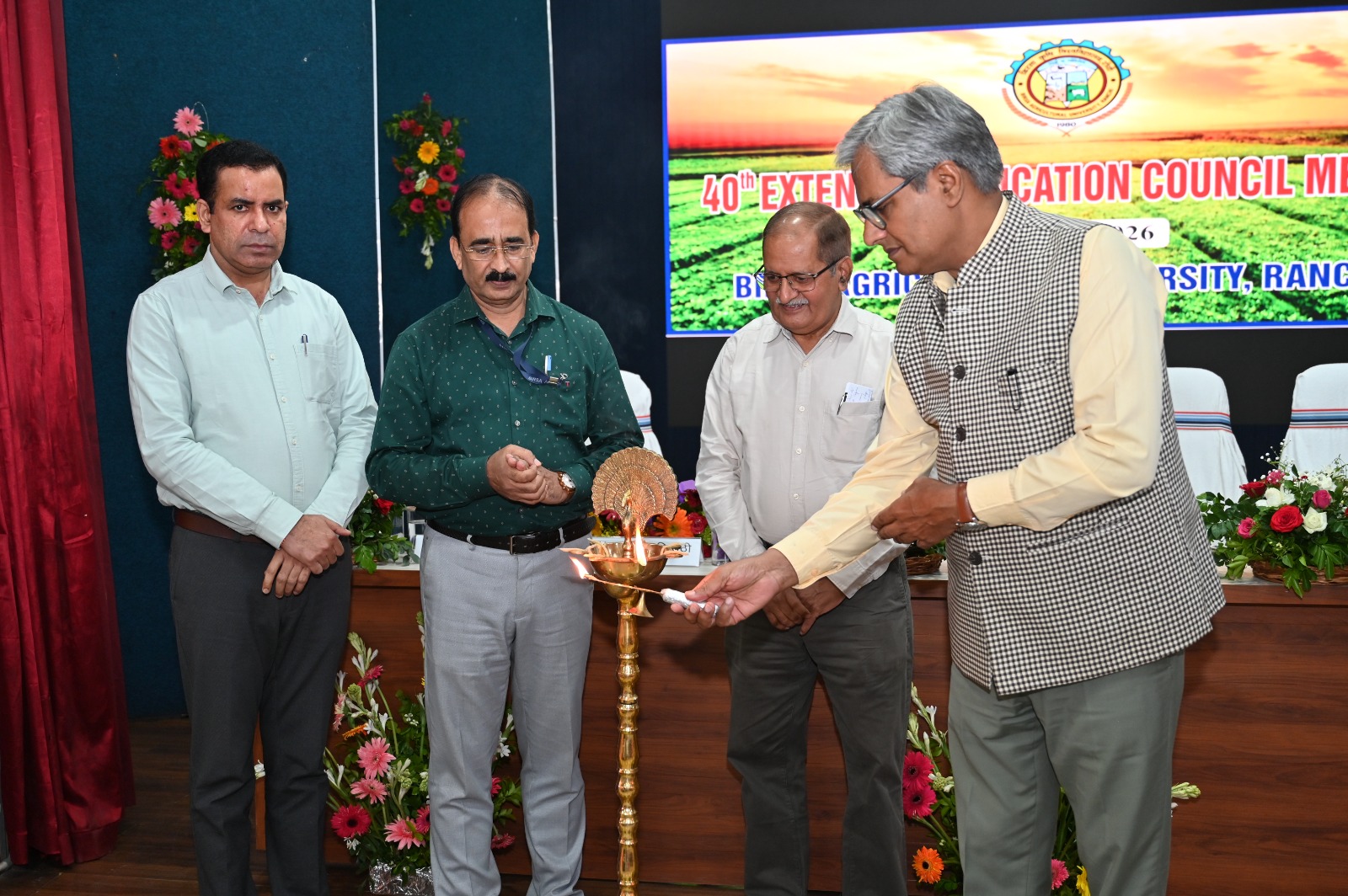
Ranchi: The Vice Chancellor of Birsa Agricultural University (BAU), Dr SC Dubey, said that Jharkhand has immense potential for floriculture and flower-based enterprises, and extension workers and farmers should gear up to harness these opportunities.
Addressing the 40th meeting of the Extension Education Council of BAU on Saturday, Dr. Dubey said that Jharkhand’s soil and climate are suitable for year-round flower cultivation, as the state does not face problems such as floods or waterlogging. He added that the proximity to Kolkata provides access to a large market. He emphasized the need to develop stronger linkages with institutions and agencies to take advantage of storage, cold chain, buy-back arrangements, and transportation facilities.
The Vice Chancellor said that extension scientists have the challenging responsibility of refining and validating developed technologies and motivating farmers to adopt them at the grassroots level. He also suggested that each Krishi Vigyan Kendras (KVKs) should develop a data repository. He stated that farmers’ incomes could be increased by up to 50 percent by reducing production costs and adding value to agricultural products.
The external expert at the meeting, Dr RK Tripathi, Technical Advisor to the National Seed Association of India and former Director Extension of the Ministry of Agriculture, GoI, said that young people in the country are increasingly moving away from agriculture, and farming ranks very low among their career preferences.
He stressed that the extension system must make effective efforts to attract and retain youth in agriculture by highlighting the opportunities and profitability of agribusiness and startups. He also noted that despite the growing use of artificial intelligence (AI), human intervention in agriculture will always remain essential.
Tasks such as drone operations, crop pest and disease surveillance, and handholding of farmers cannot be carried out solely through AI. He observed that extension scientists and workers do extensive fieldwork but often fail to adequately monitor and evaluate their activities, an area that requires greater attention.
Dr DB Singh, Principal Scientist at the ICAR–Agricultural Technology Application Research Institute (ATARI), Patna, said that the primary responsibility for transferring technologies developed by around 75 agricultural universities and 113 ICAR-research institutions across the country to farmers lies with the district-level Krishi Vigyan Kendras. Under the “Khet Bachao Abhiyan” (Save the Fields Campaign) conducted last year, scientists from 23 KVKs in Jharkhand visited more than 1,000 villages and interacted with over 103,000 farmers. He added that 27 million farmers across the country are registered on the Kisan Saathi portal to receive technical advice related to agriculture and allied sectors, including approximately 990,000 farmers from Jharkhand.
Welcoming the participants, Director of Extension Education Dr DK Shahi said that extension professionals have played a significant role in improving agricultural productivity and rural livelihoods in Jharkhand. He informed that during the previous financial year, the state’s Krishi Vigyan Kendras organized 1,622 training programmes, benefiting nearly 59,000 farmers and extension workers. Through other extension programmes, about 842,000 farmers were benefited. Similarly, the College of Veterinary Science treated and performed surgeries on more than 15,000 sick animals.
Dr Ranjay Kumar Singh presented the action action report, while Additional Director of Extension Education Dr Niranjan Lal delivered the vote of thanks.
On the occasion, three innovative farmers were honoured: Santosh Bedia of Angara for natural farming, Phalindra Mahto of Budmu for excellence in dairy farming, and Devicharan Gope of Bharno, Gumla, for successfully running a Farmers Producer Company.
Those present at the meeting included former Vice Chancellor Dr GS Dubey, former chairman of the Department of Plant Breeding and Genetics Dr ZA Haider, former chairman of the Department of Soil Science Dr BP Singh, Dr Avani Kumar Singh, Head of the ICAR Research Institute, Palandu, Dr VP Bhadana, Joint Director of IIAB and Dr Jyotirmay Ghosh, Principal Scientist at NISA.
