
Judicial Academy organises conference on Speedy & Qualitative Disposal of Cyber Crime Cases
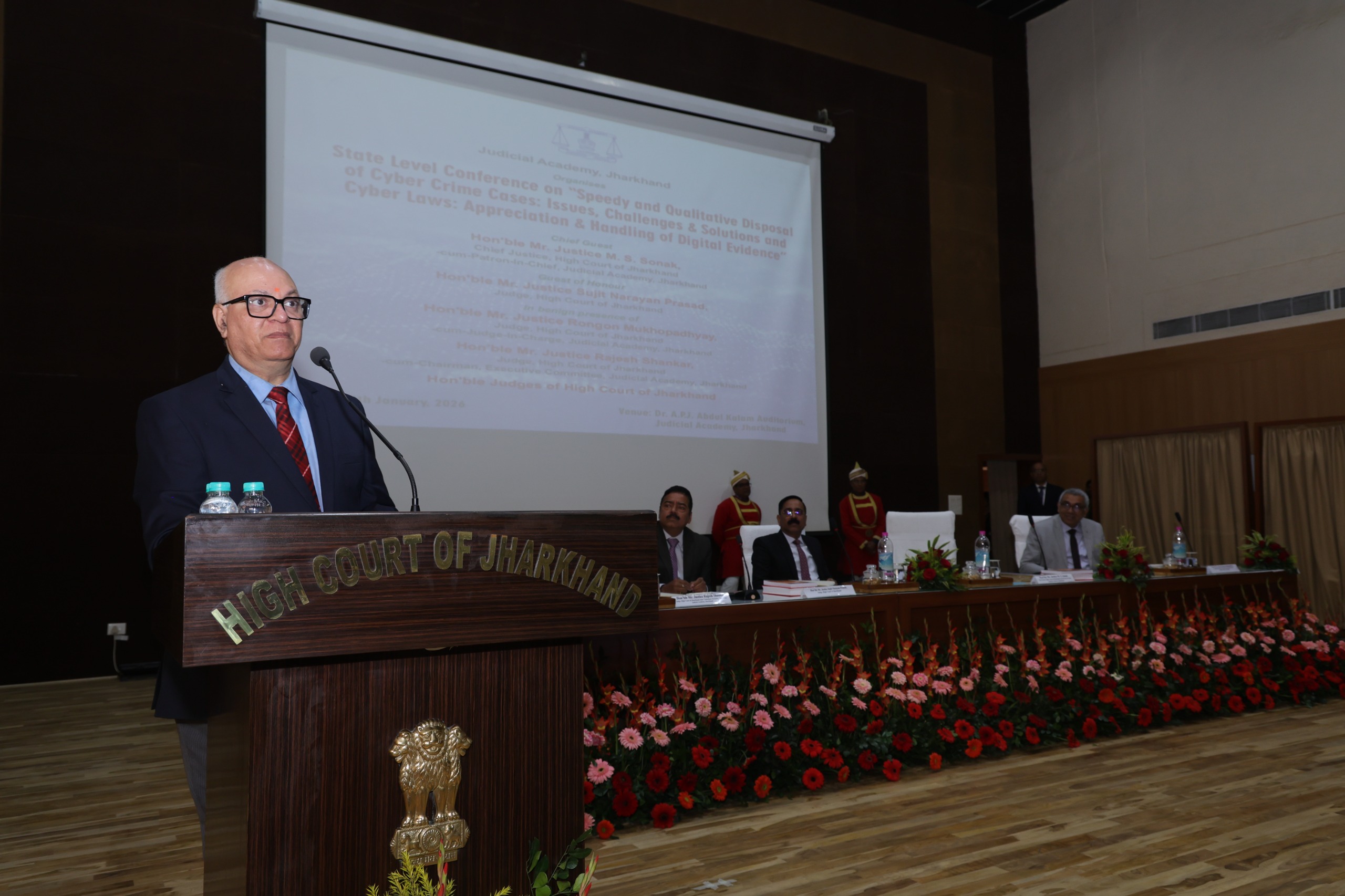
Ranchi: A State Level Conference on “Speedy & Qualitative Disposal of Cyber Crime Cases: Issues, Challenges & Solutions” was organized on 18th January 2026 by Judicial Academy Jharkhand, Ranchi under the aegis of the High Court of Jharkhand, with the aim of addressing contemporary challenges in cyber crime adjudication and identifying effective solutions.
The Conference brought together Judges of the High Court of Jharkhand, subject-matter experts, Judicial Officers from different cadres, senior officers of the State Government, police and prosecution officials, bank officers, and other key stakeholders, fostering a comprehensive and collaborative dialogue on strengthening the cyber crime justice delivery framework.
The welcome-cum-introductory address was delivered by Justice Rongon Mukhopadhyay, Judge, High Court of Jharkhand-cum-Judge-In-Charge, Judicial Academy, Jharkhand. Justice Mukhopadhyay highlighted the rapidly evolving nature of cyber-crimes and emphasized the need for continuous judicial training, institutional preparedness, and a coordinated approach among stakeholders for effective and timely disposal of cyber-crime cases.
Justice Sujit Narayan Prasad, Judge, High Court of Jharkhand delivered a special address which underscored the importance of judicial sensitivity, procedural rigor, and technological understanding while dealing with cyber offences, particularly in matters involving digital evidence and victims’ rights.
The keynote address was delivered by Justice M. S. Sonak, Chief Justice of the High Court of Jharkhand-cum-Patron-in-Chief, Judicial Academy, Jharkhand, who observed that the justice delivery system is at a critical intersection of law and technology, where cybercrime has emerged as a pervasive challenge affecting financial offences, crimes against vulnerable groups, and national security. Justice Sonak emphasized that with the proliferation of digital offences, almost every criminal court today functions as a cyber court, making cybersecurity awareness and technological competence indispensable.
Stressing the central theme of the Conference, Justice Sonak highlighted that speedy disposal must be complemented by qualitative adjudication, requiring not only sound legal knowledge but also scientific temper, technological awareness, and sensitivity. Justice Sonak cautioned against over-reliance on machines and algorithms, underscoring the need to ensure that technological advancement does not erode human judgment, constitutional values, or judicial independence, and expressed confidence that the Conference deliberations would strengthen the capacity of courts to deliver effective and just outcomes in the digital age.

The inaugural session concluded with a vote of thanks proposed by Hon’ble Mr. Justice Rajesh Shankar, Judge, High Court of Jharkhand-cum-Chairman, Executive Committee, Judicial Academy, Jharkhand, who expressed gratitude to all dignitaries, speakers, and participants for their valuable contributions.
A book titled “AI Governance: Law, Ethics and Policy”, prepared by Judicial Academy Jharkhand was formally released, reflecting the growing relevance of artificial intelligence in law, governance, and the justice delivery system.
The Conference featured three in-depth technical sessions focusing on investigation, trial, and emerging challenges in cyber crimes as well as Artificial Intelligence.
The First Technical Session on “Cyber Crime: Emerging Offences, Modus Operandi and Investigative Challenges” was addressed by Shri Jitender Singh, Assistant Commissioner of Police, Cyber Crime, New Delhi. Mr. Singh deliberated upon cyber offences under the Information Technology Act and other laws, jurisdictional complexities in registration of cyber crimes, collection and preservation of digital evidence, and challenges in cyber forensics including search, seizure, and analysis of electronic records.
The Second Technical Session on “Trial of Cyber Offences: Admissibility & Appreciation of Digital Evidence” was addressed by Dr. Prashant Mali, Advocate, Bombay High Court. Mr. Mali discussed legal and practical issues relating to relevancy, authenticity, and admissibility of electronic records, chain of custody, interpretation of Section 63 of the Bharatiya Sakshya Adhiniyam in light of judicial precedents, jurisdictional challenges in cyber crime trials, and the technological preparedness required for courts.
The Third Technical Session on “Artificial Intelligence” was addressed by Prof. (Dr.) Avinash Dadhich, Founding Director, School of Law, Dhirubhai Ambani University, Gandhinagar, Gujarat. Mr. Dadhich elaborated on AI-enabled cyber crimes, the use of artificial intelligence in cyber crime investigation and policing, data protection and cyber security obligations in criminal investigations, and the role of the judiciary and prosecutors in balancing cyber security with the right to privacy.
All technical sessions witnessed active participation and interactive discussions, enabling meaningful exchange of ideas and practical insights among judicial officers and other stakeholders. The State-Level Conference marked a significant step towards developing a holistic, informed, and future-ready approach for the speedy and qualitative disposal of cyber crime cases, while strengthening the judiciary’s capacity to effectively handle digital evidence and emerging technological challenges.

KEYNOTE ADDRESS
It is a matter of great honour and privilege for me to address this State-Level Conference on “Speedy and Qualitative Disposal of Cyber Crime Cases: Issues, Challenges and Solutions, and Cyber Laws: Appreciation and Handling of Digital Evidence.” I extend a very warm welcome to all of you to this timely and intellectually significant programme organised by the Judicial Academy, Jharkhand.
Cyberspace has become principal theatre in which contemporary crime is conceived, executed, and concealed
We meet today at a defining crossroads of law, technology, and society. Digital technologies have not merely altered the tools we use; they have transformed the very architecture of human interaction. The way we communicate, transact, govern, learn, and even conceptualise identity and privacy has been fundamentally reshaped. Inevitably, crime has migrated to this digital ecosystem. Cyberspace has become not merely a new site of offending, but the principal theatre in which contemporary crime is conceived, executed, and concealed.
Cyber crime is therefore no longer a specialised or peripheral category of offences. It now permeates financial crimes, sexual offences, organised crime, economic offences, crimes against vulnerable groups, and even activities impinging upon national security. As a consequence, almost every criminal court today is, in one sense or another, a cyber court.
This profound transformation places unprecedented responsibility upon the justice delivery system. It compels us to re-examine how crimes are investigated, how evidence is collected, preserved, and evaluated, and how adjudication itself must evolve. The central theme of this conference speedy and qualitative disposal captures this institutional challenge with remarkable precision.
Speed is crucial for preserving evidence
In cyber cases, speed is crucial for preserving evidence. Digital evidence can be easily lost or altered, as logs get overwritten, servers change, and data moves quickly across borders. Delaying investigations can mean losing key evidence needed for justice.
At the same time, cyber cases demand a far higher degree of judicial engagement. Courts are no longer dealing only with ocular testimony and physical exhibits. They are now required to assess metadata, hash values, server records, forensic images, algorithmic outputs, and cloud-based repositories. Qualitative disposal, in this context, requires not only sound legal knowledge, but scientific temper, technological awareness, and methodological rigour.
The constitutional dimension of this responsibility must never be lost sight of.
The right to speedy trial and the right to fair procedure are inseparable facets of Article 21. Speed without fairness degenerates into arbitrariness. Fairness without reasonable expedition results in denial of justice. The cyber courtroom must therefore become a space where efficiency and constitutionalism coexist in careful equilibrium.
Cyber offences today extend far beyond unauthorised access and data theft
The first technical session rightly focuses on emerging cyber offences, evolving modus operandi, and investigative challenges. Cyber offences today extend far beyond unauthorised access and data theft. We are witnessing a disturbing rise in ransomware attacks, financial phishing, cryptocurrency frauds, deepfake-based extortion, online sexual exploitation, cyber-stalking, digital blackmail, and AI-enabled impersonation. These offences are prosecuted not only under the Information Technology Act, but increasingly under the general criminal law, economic statutes, child protection laws, and other special legislations.
For courts, the central challenge lies in correctly mapping technologically mediated conduct onto statutory ingredients. Concepts such as cheating, forgery, criminal breach of trust, or obscenity now manifest through servers, bots, and virtual identities. Determining intention, knowledge, and causation in such cases requires judges to appreciate how digital systems operate and how electronic traces are generated.
Equally complex are the jurisdictional questions associated with cyber crime. Traditional criminal law was territorially grounded. Cyber crime is spatially indifferent. The offender may be in one country, the victim in another, the server in a third, and the financial trail dispersed across several jurisdictions. This unsettles conventional notions of place of occurrence, local jurisdiction, and investigative competence.
Judiciary must ensure that procedural doctrines facilitate, rather than frustrate, the administration of justice
Courts are increasingly called upon to address issues relating to registration of FIRs, territorial jurisdiction, transfer of investigations, cross-border evidence gathering, and the use of mutual legal assistance mechanisms. In doing so, the judiciary must ensure that procedural doctrines facilitate, rather than frustrate, the administration of justice, while remaining firmly anchored to statutory command and constitutional discipline.
The emphasis on collection, preservation, and integrity of digital evidence is particularly significant. Digital evidence is not a passive object; it is a dynamic entity. It can be altered remotely, replicated infinitely, or rendered inaccessible through encryption. Improper handling at the threshold stage can permanently destroy its evidentiary value.
Cyber forensics expands the investigative gaze dramatically
Judges must therefore be attentive to how electronic devices are seized, how data is imaged, how integrity is ensured through hashing, how volatile memory is captured, and how forensic environments are secured. Insistence on proper standard operating procedures is not technical formalism; it is the foundation of evidentiary credibility.
Closely linked to this is the domain of cyber forensics, the search, seizure, and analysis of electronic records. Cyber forensics expands the investigative gaze dramatically.
Entire digital lives may be encapsulated within a single device. Communications, financial histories, location data, browsing patterns, and biometric identifiers may all be implicated. This expansion of investigative power inevitably raises constitutional concerns. Digital searches can easily become disproportionate. Seizures can intrude far beyond the legitimate scope of investigation. Forensic tools may operate through processes opaque even to those who deploy them.
Courts must ensure that investigators have lawful access to technological means
The judiciary’s role here is both enabling and restraining. Courts must ensure that investigators have lawful access to technological means, while simultaneously ensuring that such access remains structured, accountable, and proportionate. Warrants, seizure records, forensic reports, and expert testimony must therefore receive careful, informed, and rights-oriented scrutiny.
AI exposed the sector to sophisticated forms of cyber fraud
I am particularly glad that officers from the banking and financial sector are also associated with this conference. The financial ecosystem today stands on the frontlines of cyber vulnerability. Digital banking platforms, real-time payment systems, fintech innovations, crypto-assets, and AI-driven financial services have greatly enhanced efficiency and financial inclusion, but they have simultaneously exposed the sector to sophisticated forms of cyber fraud, identity theft, account takeovers, deepfake-enabled social engineering, algorithmic manipulation, and large-scale data breaches.
Financial cybercrime today is no longer confined to individual deception; it increasingly manifests as organised, transnational, and technology-assisted economic crime. This conference is therefore of direct relevance to bank officers, as it deepens institutional understanding of how cyber offences are investigated, how digital financial trails are preserved, how electronic banking records are judicially scrutinised, and how emerging AI-enabled threats are legally assessed.
A sound appreciation of cyber law, digital evidence, and AI governance will empower banking institutions
A sound appreciation of cyber law, digital evidence, and AI governance will empower banking institutions to strengthen internal compliance systems, improve incident response mechanisms, support lawful investigations, and align cybersecurity practices with constitutional and regulatory expectations. In that sense, this conference is not merely a judicial exercise; it is a capacity-building platform for the entire financial ecosystem in its shared responsibility to protect economic integrity, consumer trust, and digital security.
The second technical session moves us from investigation to adjudication, to the trial of cyber offences and the admissibility and appreciation of digital evidence. Relevancy, authenticity, and admissibility of electronic records now lie at the heart of criminal adjudication. In the digital environment, the notion of an “original” is transformed. Authorship may be distributed.
Adopt a disciplined and scientifically informed approach
Content may be auto-generated. Alteration may leave no visible trace. Courts are therefore required to adopt a disciplined and scientifically informed approach to evaluating digital material examining not merely what appears on a screen, but how that data was created, stored, transmitted, and produced. Contextual corroboration, forensic explanation, and procedural compliance assume decisive importance.
In cyber cases, maintaining a meticulous chain of custody is paramount. As digital evidence traverses multiple devices, forensic tools, analysts, and storage environments, each transfer point presents a potential vulnerability. Any unexplained break in the chain compromises credibility, while undocumented interventions sow doubt. Consequently, judicial insistence on a continuous, auditable, and verifiable chain of custody is essential.
The judiciary has established a robust framework for the admissibility of digital evidence, as seen in landmark cases such as Arjun Panditrao Khotkar (2020), and has consistently reinforced this jurisprudence in subsequent decisions. Furthermore, guidelines have been formulated to ensure the integrity of digital evidence and maintain a secure chain of custody. Notably, the Hon’ble Karnataka High Court, in Virendra Khanna v. State of Karnataka (2021) and Madhukara v. State of Karnataka (2018), has issued directives for Trial Courts, Investigating Officers, and Government Authorities, such as FSL, regarding the collection and presentation of electronic evidence.
The focus on Section 63 of the Bharatiya Sakshya Adhiniyam and the jurisprudence evolved from Section 65-B of the Evidence Act underscores that electronic evidence is admissible not merely because it exists, but because it is produced in a manner that assures its authenticity and integrity. The deeper purpose of this jurisprudence is to cultivate a culture of evidentiary discipline grounded in scientific reliability.
AI is rapidly transforming both cyber crime and cyber policing
The third technical session takes us further into the future, addressing artificial intelligence, cyber security, and data protection as emerging challenges for investigation, prosecution, and adjudication. Artificial intelligence is rapidly transforming both cyber crime and cyber policing. We are witnessing AI-enabled crimes through deepfakes, automated frauds, synthetic identities, and algorithmic manipulation.
These developments raise profound questions for criminal law: How is intention assessed when conduct is automated? How is responsibility attributed in complex socio-technical systems? How is proof constructed when causation is algorithmically mediated?
Simultaneously, artificial intelligence is increasingly deployed in investigation and policing through pattern recognition, predictive analytics, facial recognition, and automated surveillance. While these tools promise efficiency, they also raise serious concerns of bias, opacity, accountability, and proportionality. The judiciary must therefore ensure that technological empowerment does not become constitutional erosion.
The session’s emphasis on data protection law and cyber security obligations is particularly vital. Contemporary investigations routinely process enormous volumes of personal data, often of individuals who are not accused of any offence. Cyber security failures within justice institutions are no longer mere administrative lapses; they are breaches of constitutional trust. Courts will increasingly be called upon to supervise how data is collected, stored, used, and secured.
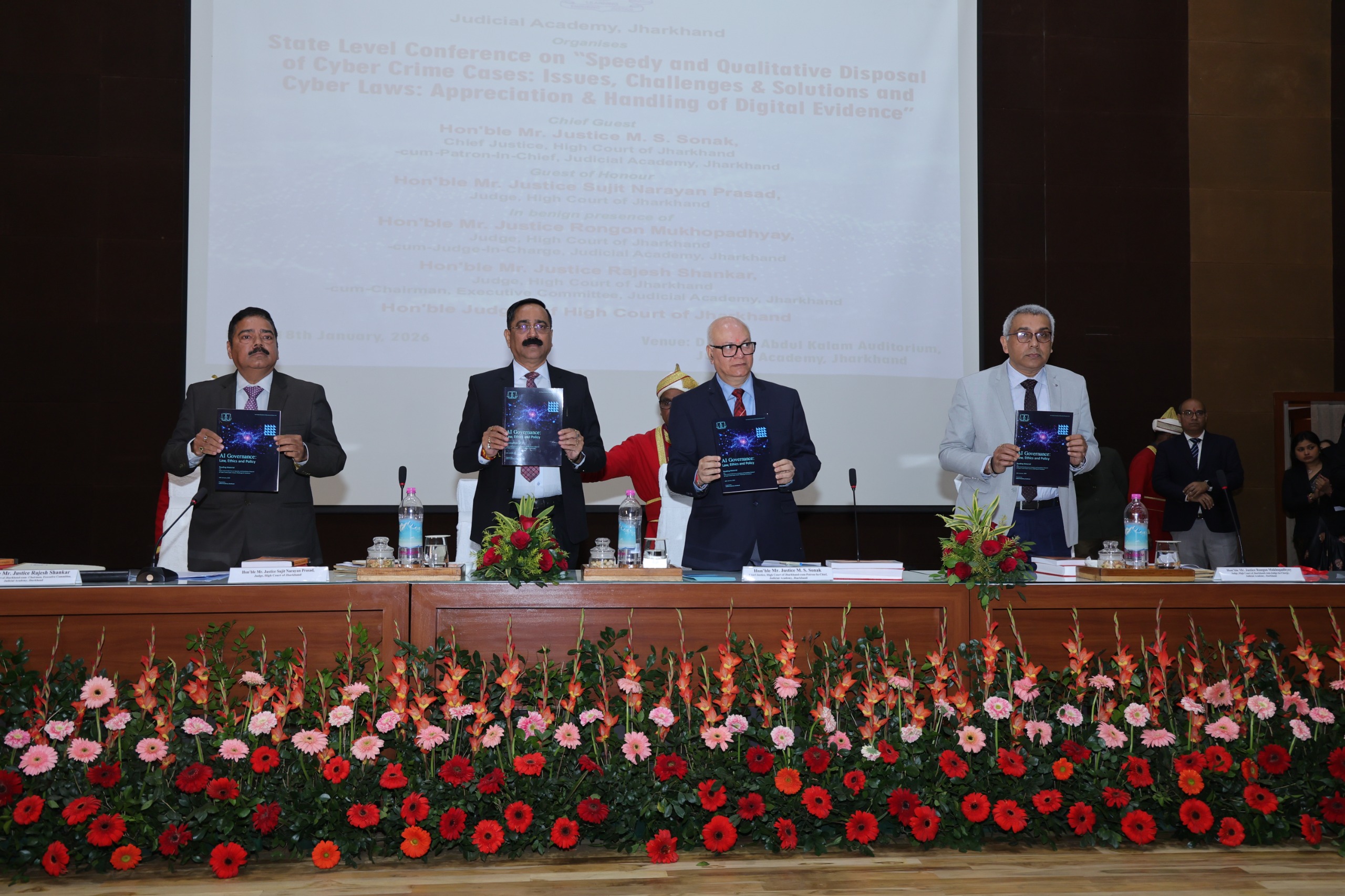
Book ‘AI Governance: Law, Ethics and Policy’: A thoughtful response to the growing influence of artificial intelligence in public administration
This brings me to the significance of the book being released today, “AI Governance: Law, Ethics and Policy.” This publication, prepared by the Judicial Academy, Jharkhand, is a timely and thoughtful response to the growing influence of artificial intelligence in public administration and the justice delivery system. The book situates technological advancement firmly within the framework of constitutional values, ethical restraint, and institutional accountability.
As reflected in its conceptual framework, the publication does not advocate either uncritical adoption or outright rejection of artificial intelligence. Rather, it promotes an informed, cautious, and principled engagement with technology. It examines the evolution and functioning of AI systems, surveys global regulatory and ethical approaches, analyses India’s developing AI ecosystem, and devotes particular attention to the judiciary, police, and prosecution, domains where personal liberty, human dignity, and fundamental rights are most directly implicated.
The book emphasises that artificial intelligence may assist the justice system in managing information, enhancing efficiency, and supporting institutional processes, but it cannot be permitted to dilute human responsibility or displace judicial discretion. It underscores that meaningful human control, transparency, accountability, and constitutional oversight must remain central to any technological integration within courts and allied institutions. In this sense, the publication is not merely a reading material; it is an institutional statement of values.
The Judicial Academy is to be commended for undertaking this scholarly initiative. Continuous judicial education, interdisciplinary engagement, and institutional preparedness will be indispensable as courts confront the realities of algorithmic governance and AI-mediated evidence.
Before I conclude, I wish to emphasise that cyber justice is no longer a specialised domain. It is rapidly becoming the mainstream of criminal adjudication. Our collective challenge is to ensure that technological complexity does not obscure constitutional simplicity that the commitments to liberty, dignity, fairness, and the rule of law remain visible even amidst algorithms and automation.
Speedy and qualitative disposal of cyber crime cases is therefore not merely an administrative aspiration. It is a constitutional mandate, an institutional duty, and a societal necessity.
I am confident that the deliberations of this conference will meaningfully contribute to strengthening our collective capacity to meet this challenge.
I commend the Judicial Academy, the organising committee, and all speakers for their vision and scholarly engagement. I wish the conference every success.
Thank you.
