
Sanskrit is a repository of scientific truths: Gopal Pathak
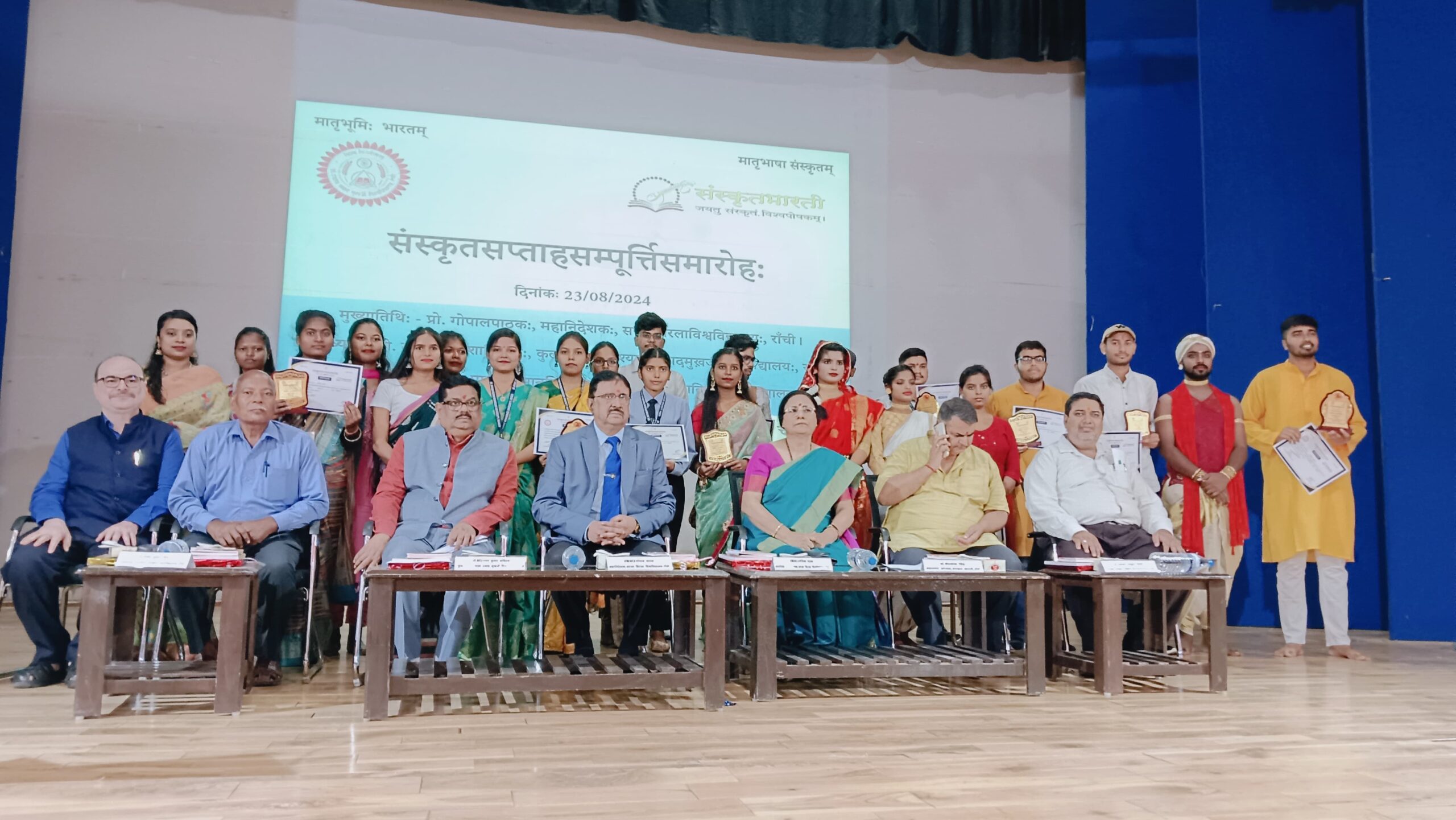
Ranchi: Sarla Birla University director Prof. (Dr.) Gopal Pathak, on the concluding day of Sanskrit Week at Dr Shayama Prasad Murkherjee Univsersity on Friday said in the present age, as the world delves deeper into the enigmatic realms of technology, modern scientists are increasingly seeking refuge in the profound wisdom embedded within ancient Sanskrit literature.
Addressing the students at the valedictory ceremony Dr. Pathak highlighted that Sanskrit is a repository of scientific truths. In contemporary times, scholars are turning to Sanskrit texts, with the Indian Institutes of Technology (IITs) fostering the study of this classical language and organizing camps to promote Sanskrit conversation. He further observed that even universities in the United States have embraced the teaching of Sanskrit, where meticulous research on its linguistic nuances is underway. Prof. Pathak asserted that Sanskrit, bridging the chasm between antiquity and modernity, paves the way for the future, serving as the very soul of India.
In his presidential address, Dr. Tapan Kumar Shandilya, the illustrious Vice-Chancellor of Dr. Shyama Prasad Mukherjee University, Ranchi, remarked that Sanskrit is far more than a mere language; it is the bedrock of our culture, tradition, and philosophy of life. This venerable language encapsulates the immense reservoir of knowledge meticulously preserved by our sages, seers, and philosophers through the ages. He further elucidated that to truly grasp the significance of Sanskrit, one must consider its omnipresence and timeless relevance. Sanskrit is the cradle not only of religious scriptures but also of seminal works in science, mathematics, medicine, astronomy, grammar, and poetry. From the Ayurvedic texts to the Yoga Sutras, from Panini’s Ashtadhyayi to Bharata’s Natyashastra, Sanskrit has illuminated every facet of human endeavor.
Prof. Shandilya further expounded that in today’s era, where science and technology have reshaped our world, the relevance of Sanskrit has surged. The study of Sanskrit not only sharpens our intellectual faculties but also imparts the wisdom of leading a balanced and cultured life. He underscored that Sanskrit is the flag-bearer of our cultural heritage, and preserving it is our sacred duty.
On this august occasion, Prof. (Dr.) Neelima Pathak, Dean of the Faculty of Humanities at Sarla Birla University, Ranchi, opined that Sanskrit is not merely an ancient tongue; it is one of the most scientific languages known to human civilization. This language has been an unparalleled medium for literary and philosophical discourse, with its grammar, word formation, and structure reflecting a scientific rigor that is second to none.
The grammar of Sanskrit, meticulously codified by Panini in the Ashtadhyayi, stands as a paragon of linguistic excellence. Panini’s systematic arrangement of words and sentences in Sanskrit renders it more scientific and structured than any other language. To fully comprehend the scientific underpinnings of Sanskrit, one must delve into its grammar, the root system, and the processes of word formation. Panini’s root system reveals the foundational essence of each verb, from which myriad words are derived, showcasing the language’s inherent flexibility and purity. This root system is a testament to the precision and scientific organization that characterizes Sanskrit.
Introducing the topic, Dr. Dhananjay Vasudev Dwivedi, Head of the Sanskrit Department at Dr. Shyama Prasad Mukherjee University, Ranchi, proclaimed that understanding Indian culture without a command of Sanskrit is akin to grasping at straws, as the Vedas, Upanishads, Puranas, and all sacred scriptures are penned in this language. The entirety of India’s ancient knowledge tradition is enshrined in Sanskrit. He further elaborated that the insights of our sages in various scientific disciplines remain invaluable.
The principles propounded by mathematicians such as Bhaskaracharya, Brahmagupta, and Sridharacharya continue to be the subject of scholarly contemplation. The theorem commonly attributed to Pythagoras was, in fact, articulated much earlier by the sage Baudhayana. Dr. Dwivedi also emphasized that Sanskrit has a pivotal role to play in the establishment of global peace.
Dr. Shriprakash Singh, Metropolitan President of Sanskrit Bharati, presented a comprehensive report on the various activities organized during Sanskrit Week.
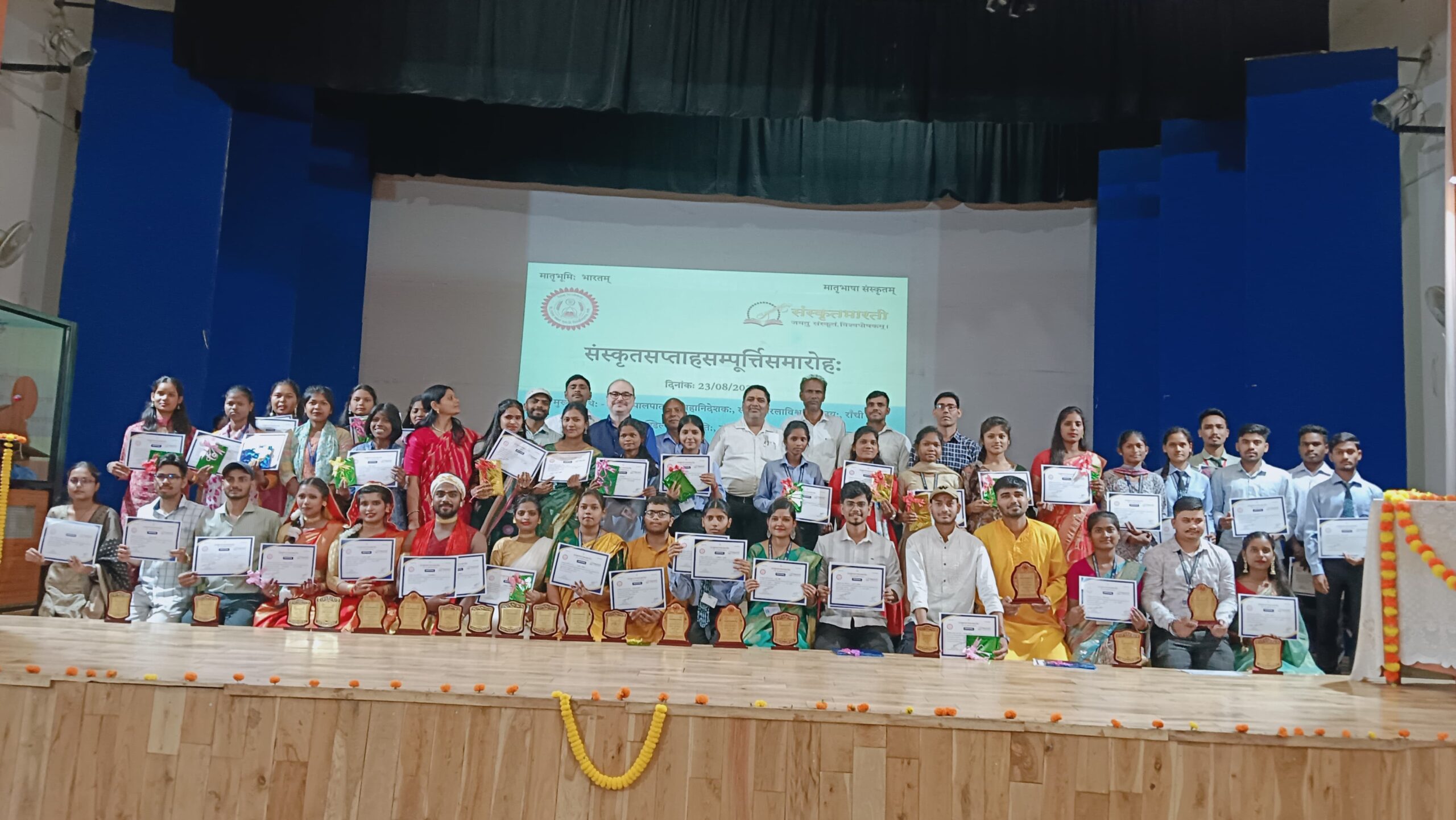
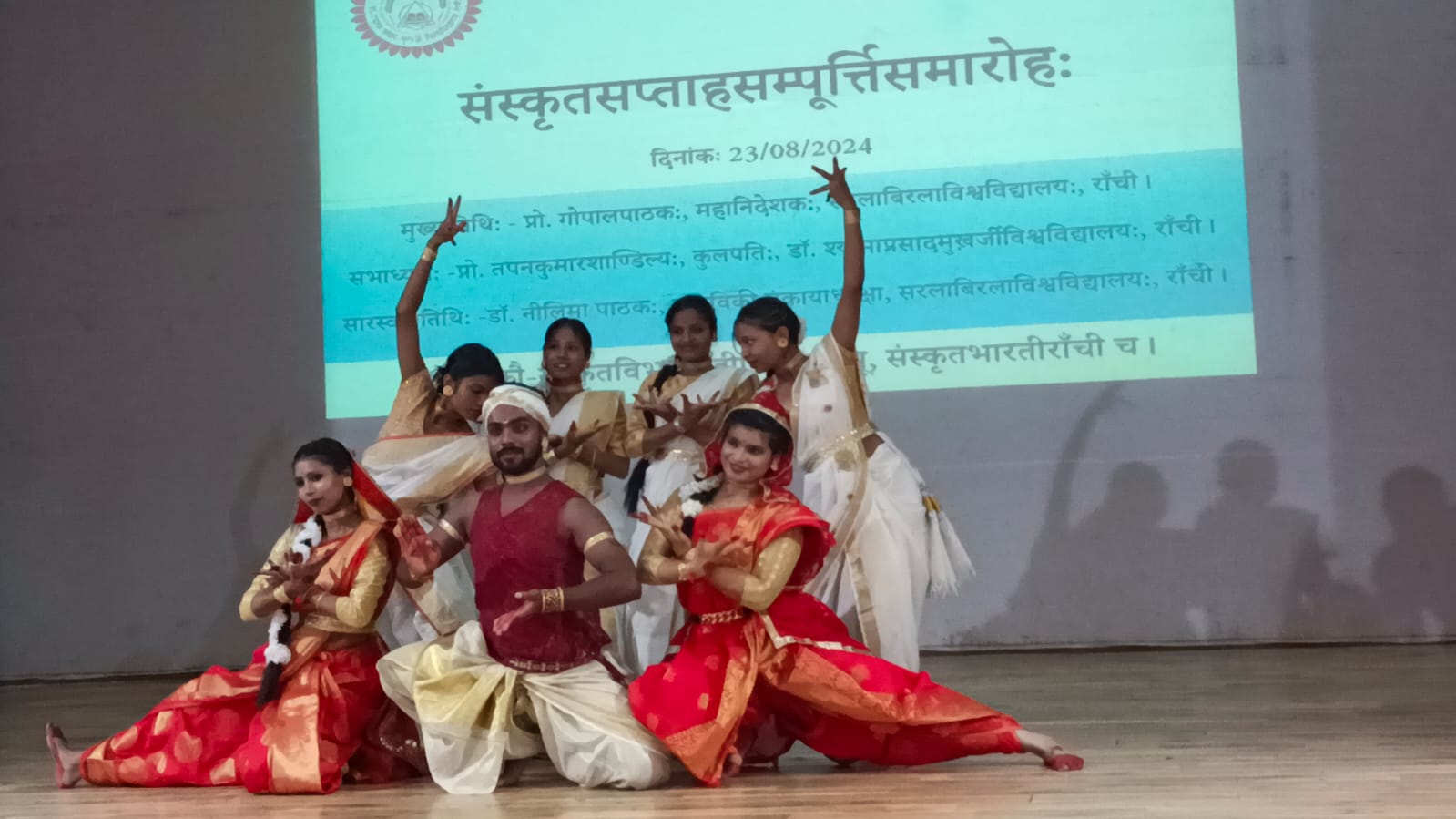
The ceremony witnessed the felicitation of winners from the various competitions held throughout the week. The event commenced with a Vedic invocation. Dr. Shreemitra, a distinguished faculty member, delivered the welcome address, followed by a melodious welcome song rendered by Manisha Bodra. Solo performances were given by Sarvottama Kumari and Tanu Kumari, while a group dance was performed by Sarjana Rathore and her ensemble. The proceedings were deftly managed by Dr. Shailesh Kumar Mishra, and the vote of thanks was graciously delivered by Dr. Jagdamba Prasad.
