
Sanskrit is not just about linguistic knowledge but is also a path to self-realization and liberation: Swami Divyadev
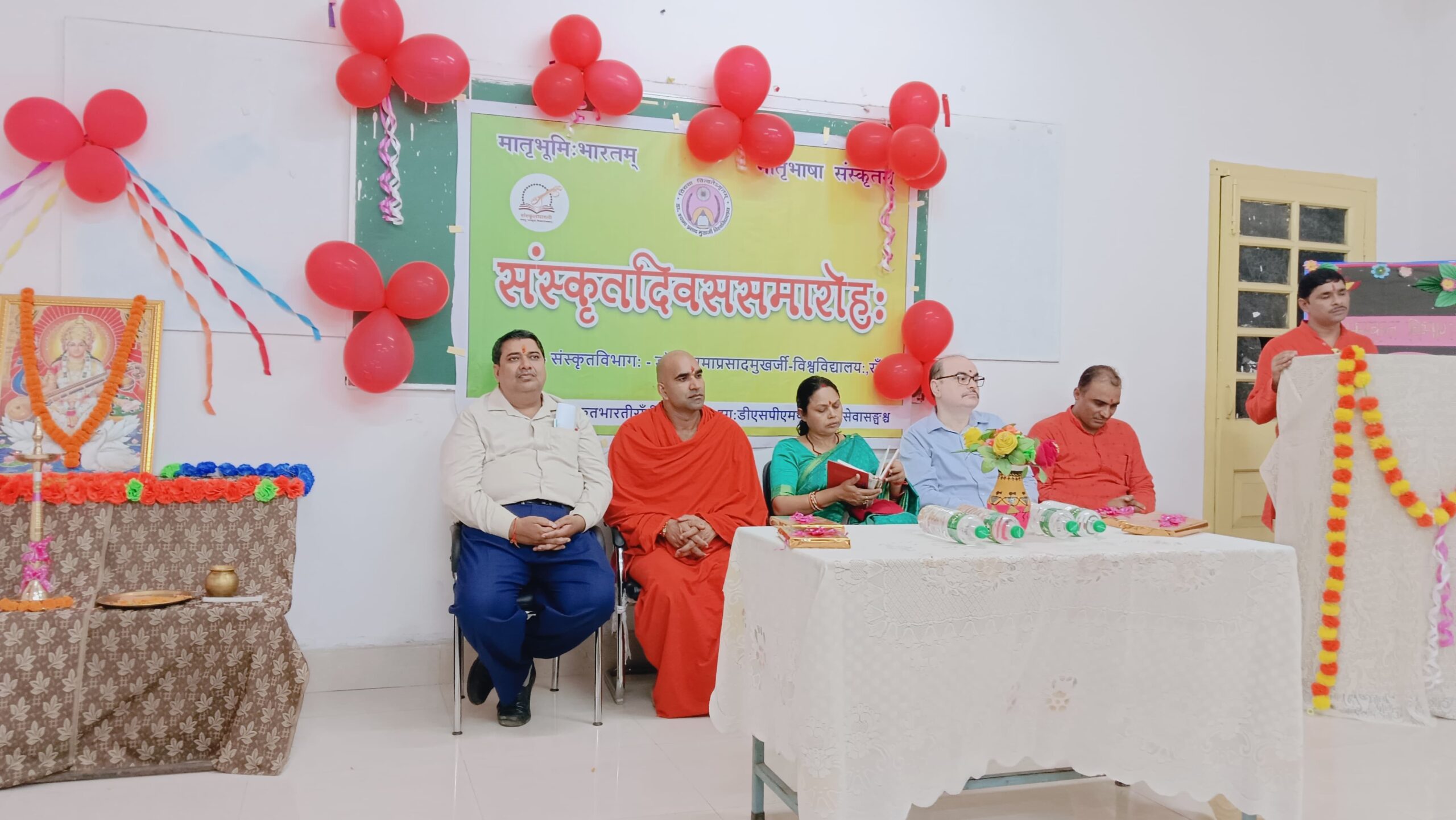
Ranchi: On the occasion of World Sanskrit Day, a grand ceremony was organized under the joint auspices of the Sanskrit Department of Dr. Shyama Prasad Mukherjee University, Ranchi, Sanskrit Bharati, and Sanskrit Seva Sangh.
The chief guest of the ceremony, Swami Divyadev, the Director of Acharyakulam, emphasized the spiritual and religious significance of the Sanskrit language, referring to it as the “language of the gods.” In his address, Swami Divyadev stated that the Vedas, Upanishads, Gita, and other religious texts composed in Sanskrit form the foundation of Indian culture.
He further mentioned that studying Sanskrit is not just about linguistic knowledge but is also a path to self-realization and liberation. Swami Divyadev highlighted the necessity of Sanskrit in the realms of religion, yoga, and meditation, presenting it as a spiritual journey.
Distancing oneself from Sanskrit is akin to distancing oneself from one’s culture: Archana Kumari Dubey
The special guest of the program, Professor Archana Kumari Dubey, Dean of the Humanities Faculty at Ranchi University, discussed the influence of Sanskrit on Indian languages. She mentioned that Jharkhand is a multilingual state where various languages and dialects are spoken, and Sanskrit has had a significant historical and cultural impact on these languages.
Although the direct grammatical influence of Sanskrit is limited, the presence of “Tatsam” and “Tadbhav” words has added diversity to the structure of these languages. Professor Dubey remarked that distancing oneself from Sanskrit is akin to distancing oneself from one’s culture, and in today’s era of increasing consumerism, Sanskrit becomes even more relevant.
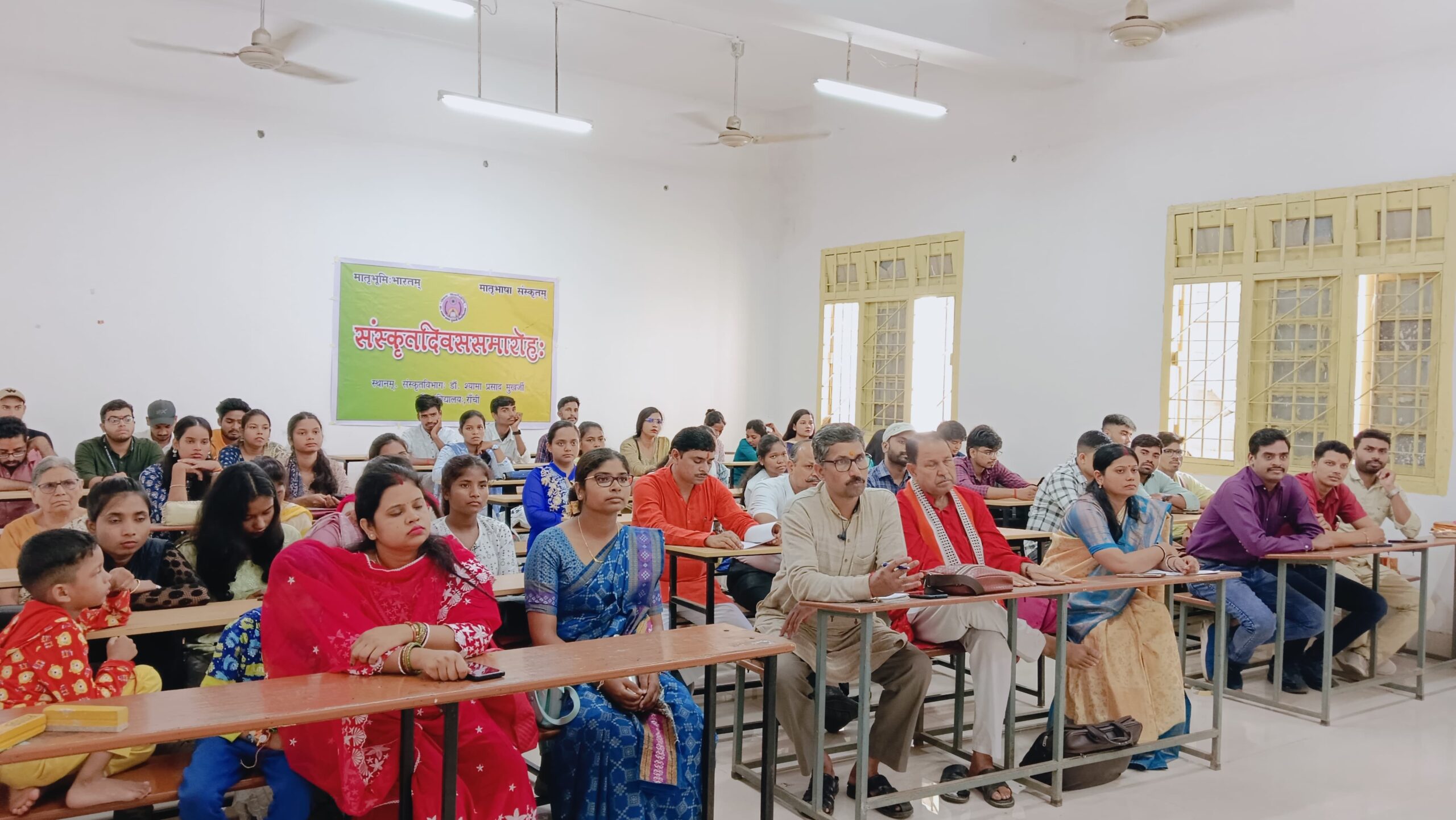
Sanskrit not only helps understanding past but also leads toward a prosperous and balanced future: Dr. Shailesh Kumar Mishra
Dr. Shailesh Kumar Mishra, President of the Jharkhand Sanskrit Academy, shed light on the literary and philosophical aspects of Sanskrit literature. He pointed out that apart from religious and spiritual texts, Sanskrit has also contributed significantly to subjects like science, medicine, and mathematics. Dr. Mishra highlighted the multifaceted contributions of Sanskrit by mentioning Panini’s “Ashtadhyayi,” the Charaka Samhita, and the works of Aryabhata. He asserted that the study of Sanskrit not only helps in understanding our past but also guides us toward a prosperous and balanced future.
Study of simple grammar, verses, and literature in Sanskrit sparks interest: Dr. Dhananjay Vasudev Dwivedi
On this occasion, Dr. Dhananjay Vasudev Dwivedi, Head of the Sanskrit Department, in his presidential address, discussed the utility of the Sanskrit language in the modern context. He stated that Sanskrit is not just a heritage of the past but is equally relevant in the present age. Through Sanskrit, we can not only preserve our cultural values but also apply them in modern science and technology. Dr. Dwivedi emphasized that the study of Sanskrit is a significant heritage for Indian youth, which they should embrace with pride.
To uplift Sanskrit, Dr. Dwivedi stressed the need to make it a mandatory subject at school and college levels. He suggested that the study of simple grammar, verses, and literature in Sanskrit at the initial stages could spark interest in the language among students. Sanskrit literature and texts should be translated into various languages and made accessible to the general public, so they can understand the importance of Sanskrit and be motivated to study it. He also emphasized making Sanskrit available on digital platforms.
Sanskrit is not just a language but the soul of Indian culture and civilization: Chandramadhav Singh
Chandramadhav Singh, the Regional Education Head of Sanskrit Bharati, emphasized the antiquity and scientific nature of the Sanskrit language. He stated that Sanskrit is not just a language but the soul of Indian culture and civilization. The knowledge embedded in Sanskrit has given the world many important philosophies. He stressed the need to raise awareness for the preservation of Sanskrit and to attract young people to this language.
Hindi professor explains vastness of Sanskrit
Dr. Seema Chaudhary, a professor from the Hindi Department of Marwari College, highlighted the importance of the Sanskrit language. Dr. Jungbahadur Pandey, a retired professor from the Hindi Department of Ranchi University, spoke about the vastness of the Sanskrit language.
The program began with the lighting of lamps and a Vedic invocation. This was followed by the recitation of Sanskrit songs and peace mantras, which made the atmosphere more sacred and spiritual. The event was hosted by Dr. Jagdamba Prasad, with a vote of thanks given by Shrimatra.
The introduction of guests was conducted by Dr. Rahul Kumar. The program played a significant role in re-establishing the importance of the Sanskrit language and raising awareness about its preservation. Amitabh Kumar, Gopal Krishna Dubey, Ashish Kumar, Ayush Kumar, Surendra Kumar, Shubham Pandey, Tanu Singh, Shweta Agarwal, Pallavi, Anisha, and others played important roles in making the event successful.
